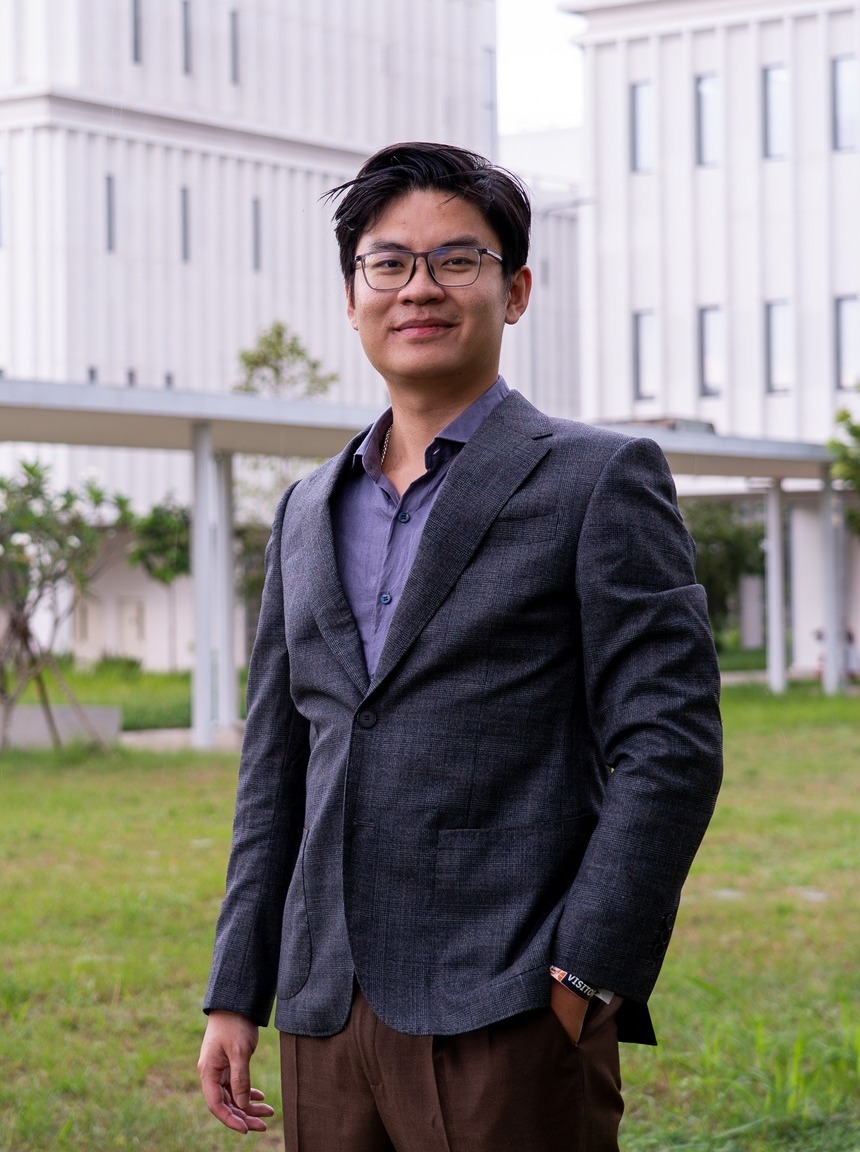
Portrait of An Thai Le

Robotics · Learning · Control

An Thai Le

Assistant Professor, VinUniversity
Visiting Professor, TU Darmstadt · Director of Foundation AI, VinRobotics

I study how robots can plan, learn, and act reliably with limited computation and data.

Our group develops parallel motion planners, robot foundation models that need less data and computation, and force-aware controllers for heavy humanoids. Our goal is to help robots move and manipulate objects reliably, including during physical contact.

Interested in exploring things together? I welcome curious students and collaborators.

Latest news

Earlier news

Research

Research slides

Efficient algorithmic robotics

We design planning, learning, and control algorithms around the robot's task and available hardware. We use tensor operations to parallelize search, compress policies for onboard inference, and learn controllers that respond to contact and changing loads. We measure efficiency through task performance, data use, memory, and latency.

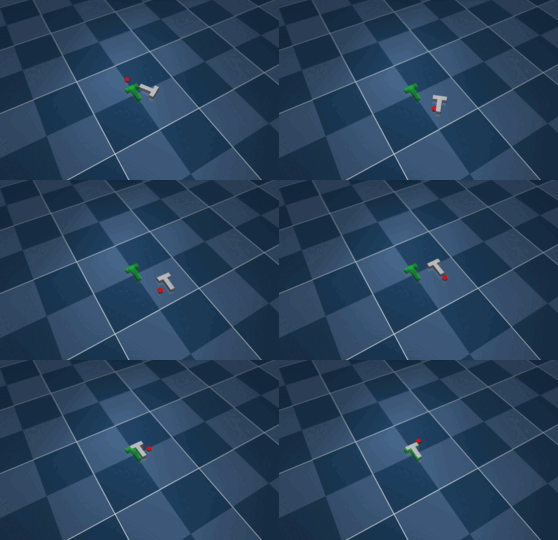
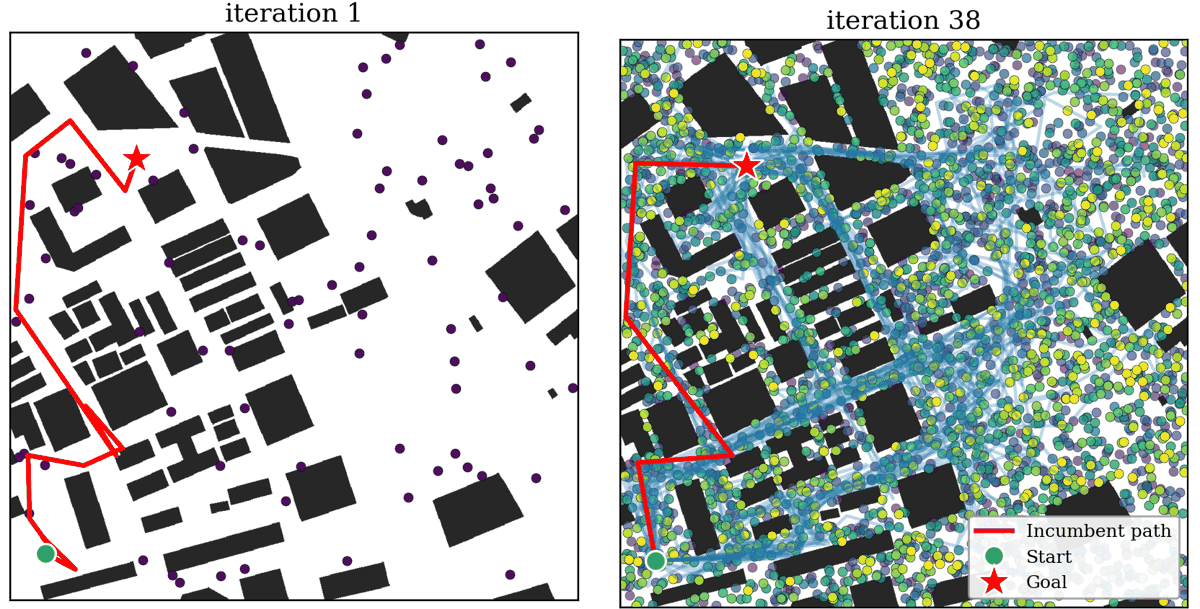
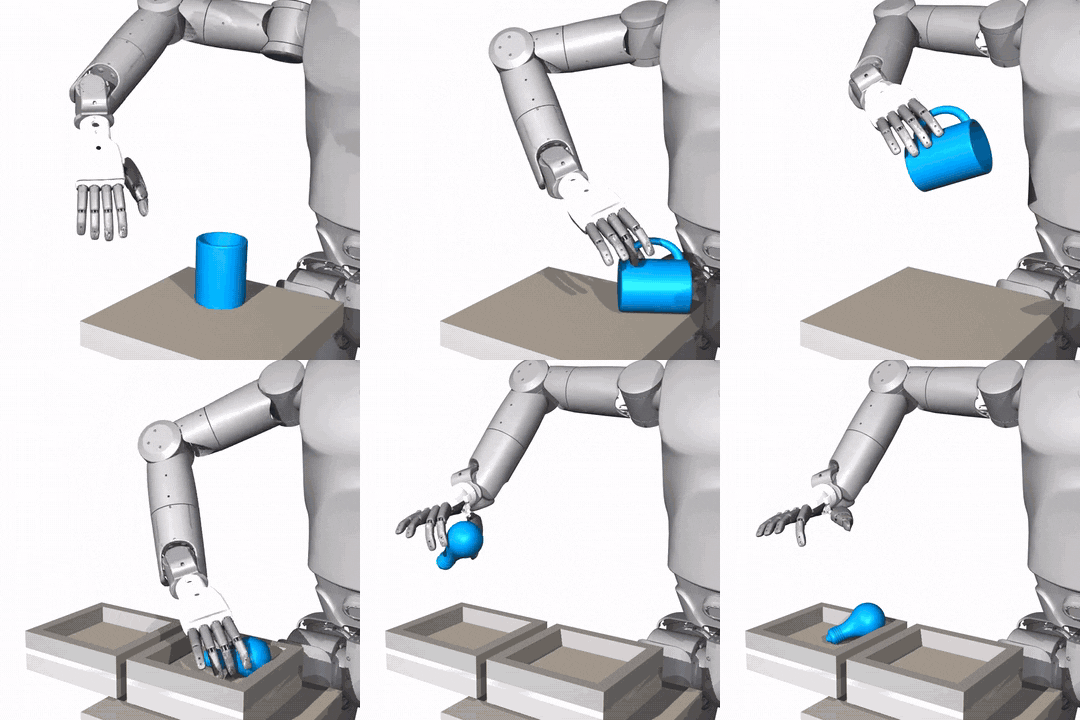
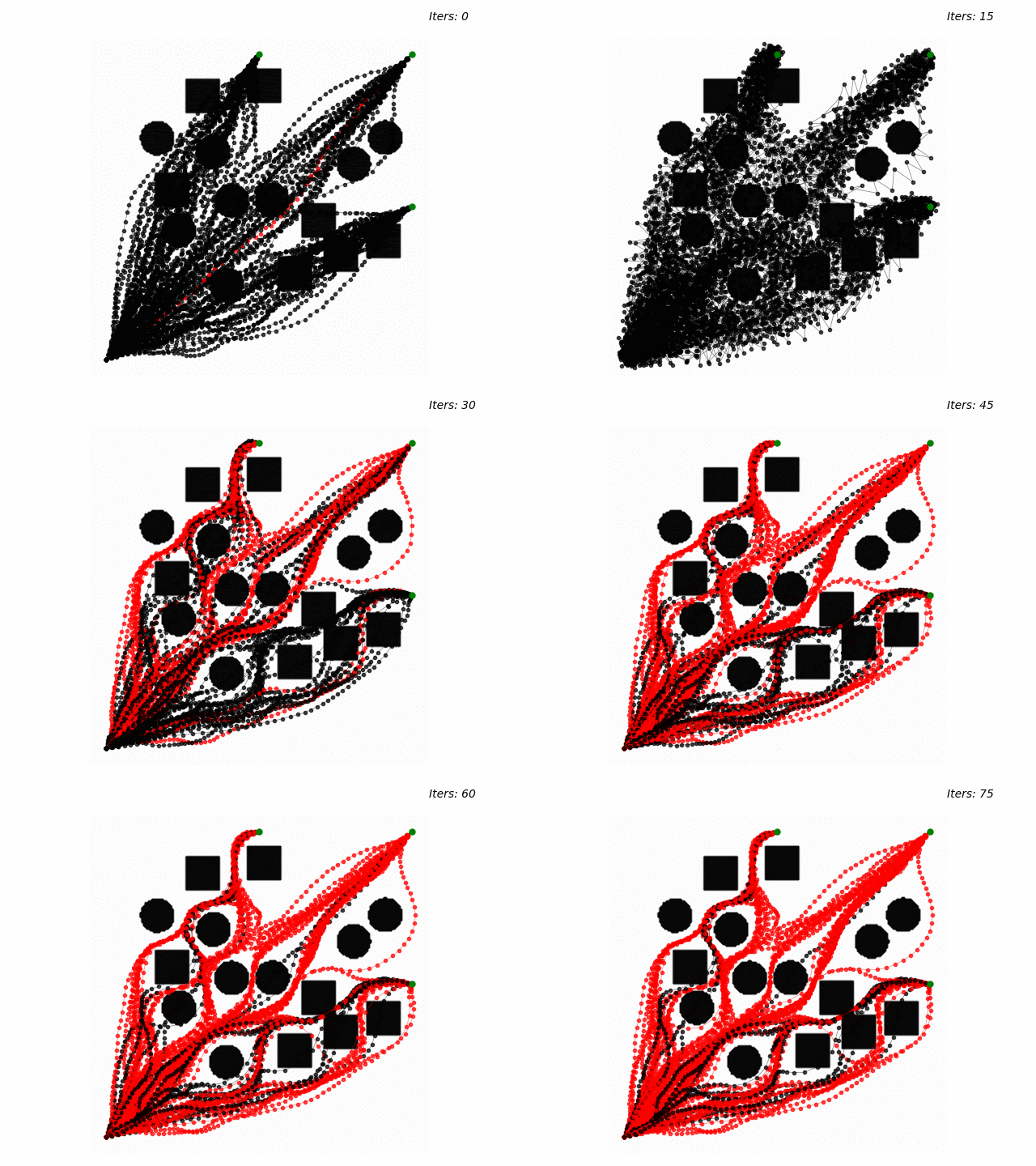
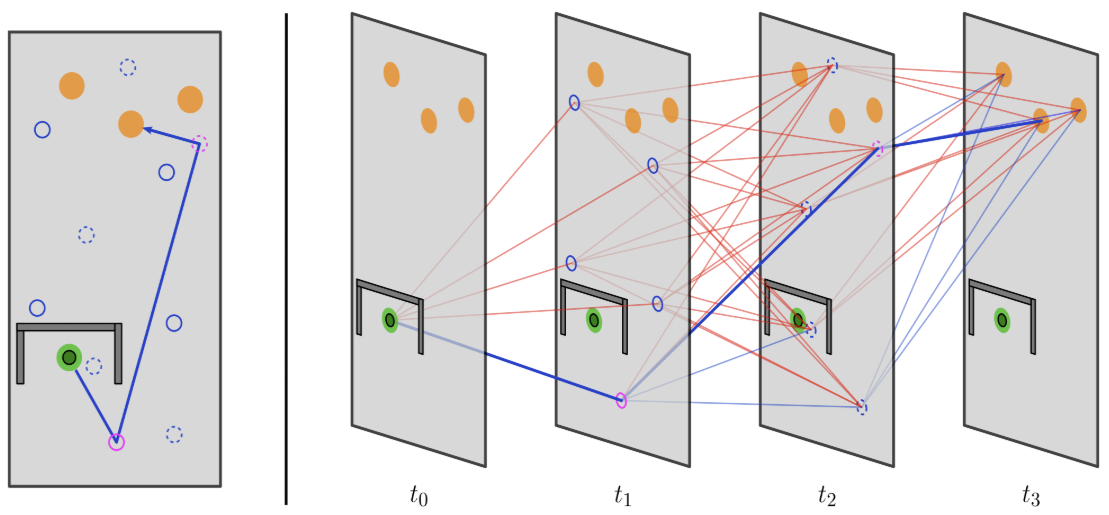
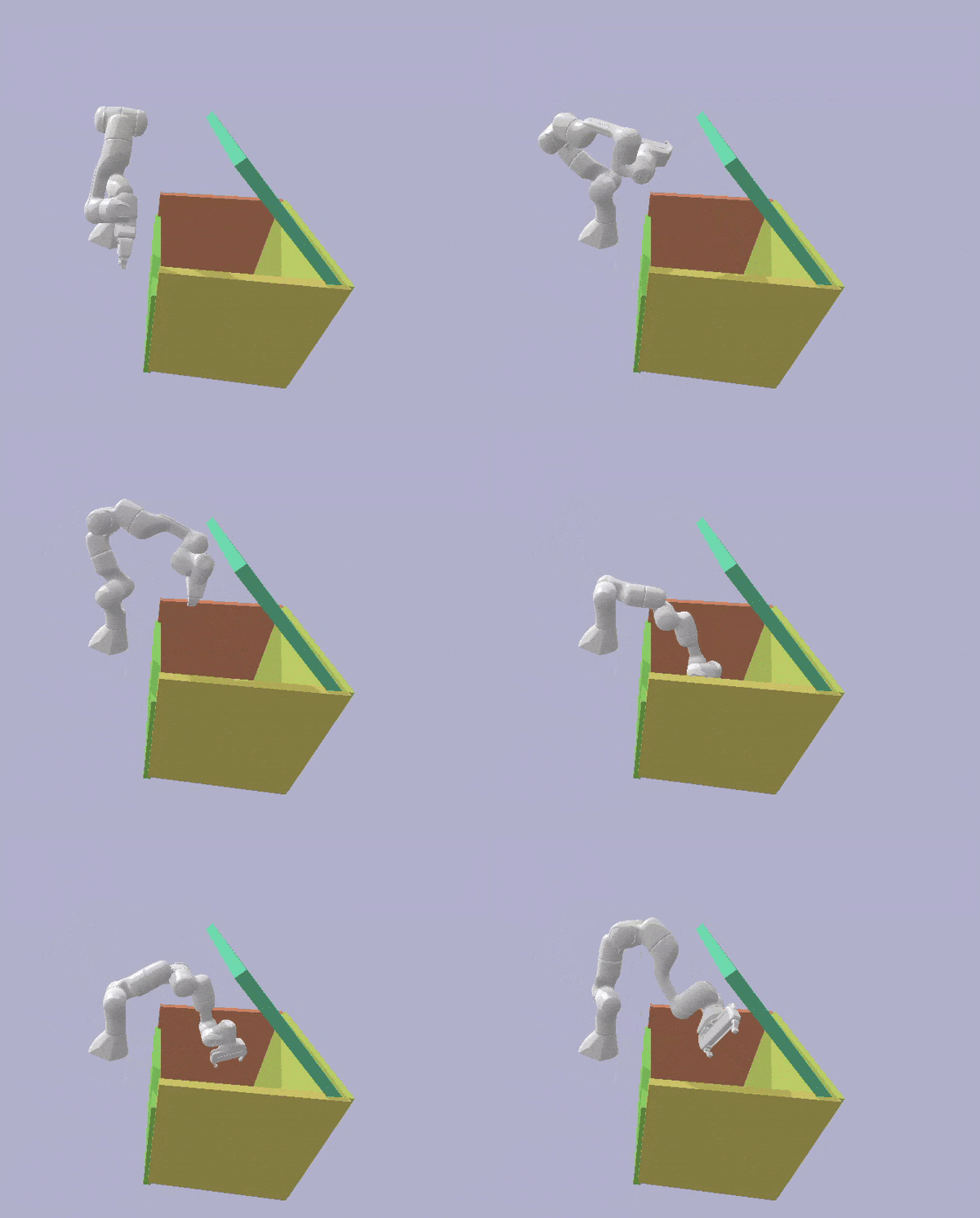
Global Tensor Motion Planning: a layered graph and batches of candidate motion plans
Tensor search · diverse motion plans

01 / Robot learning & planning

Representations for efficient algorithms

How can a change of representation simplify an algorithm and expose more parallel computation?

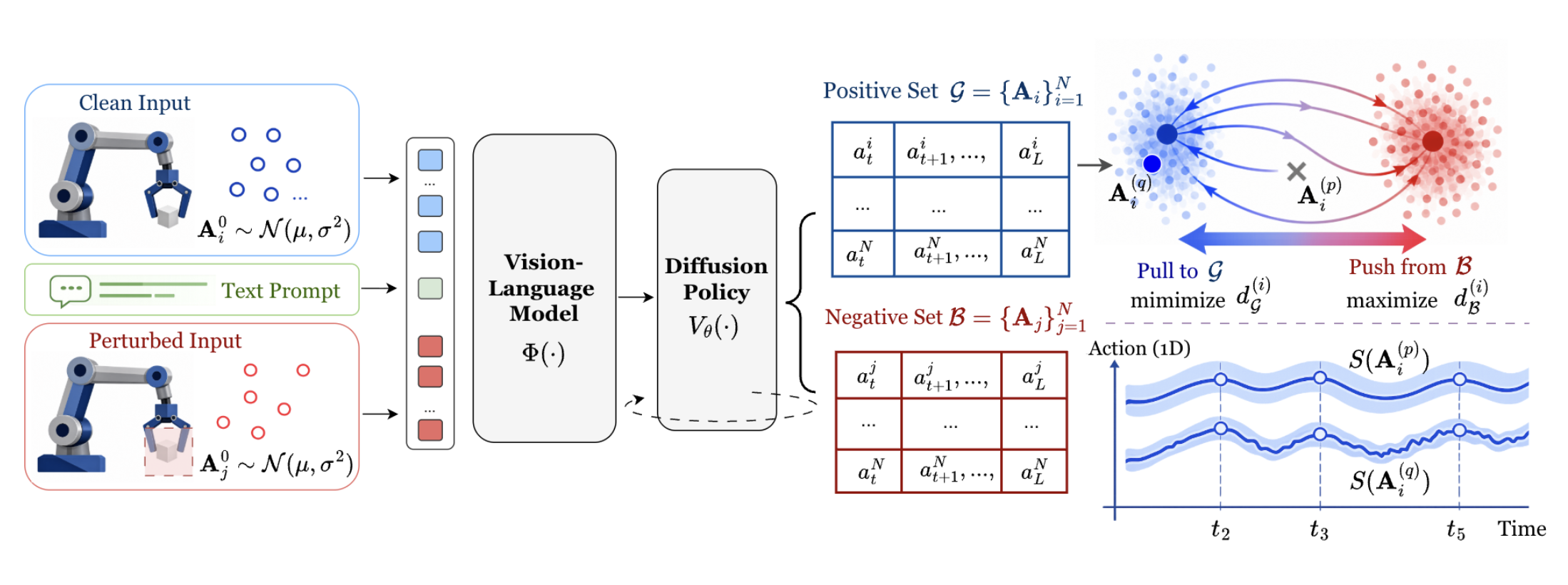
We represent candidate paths and their costs as tensors so GPUs can evaluate many plans in parallel. Our work covers graph search, optimal transport, and learned trajectory priors, including analysis of completeness and convergence.

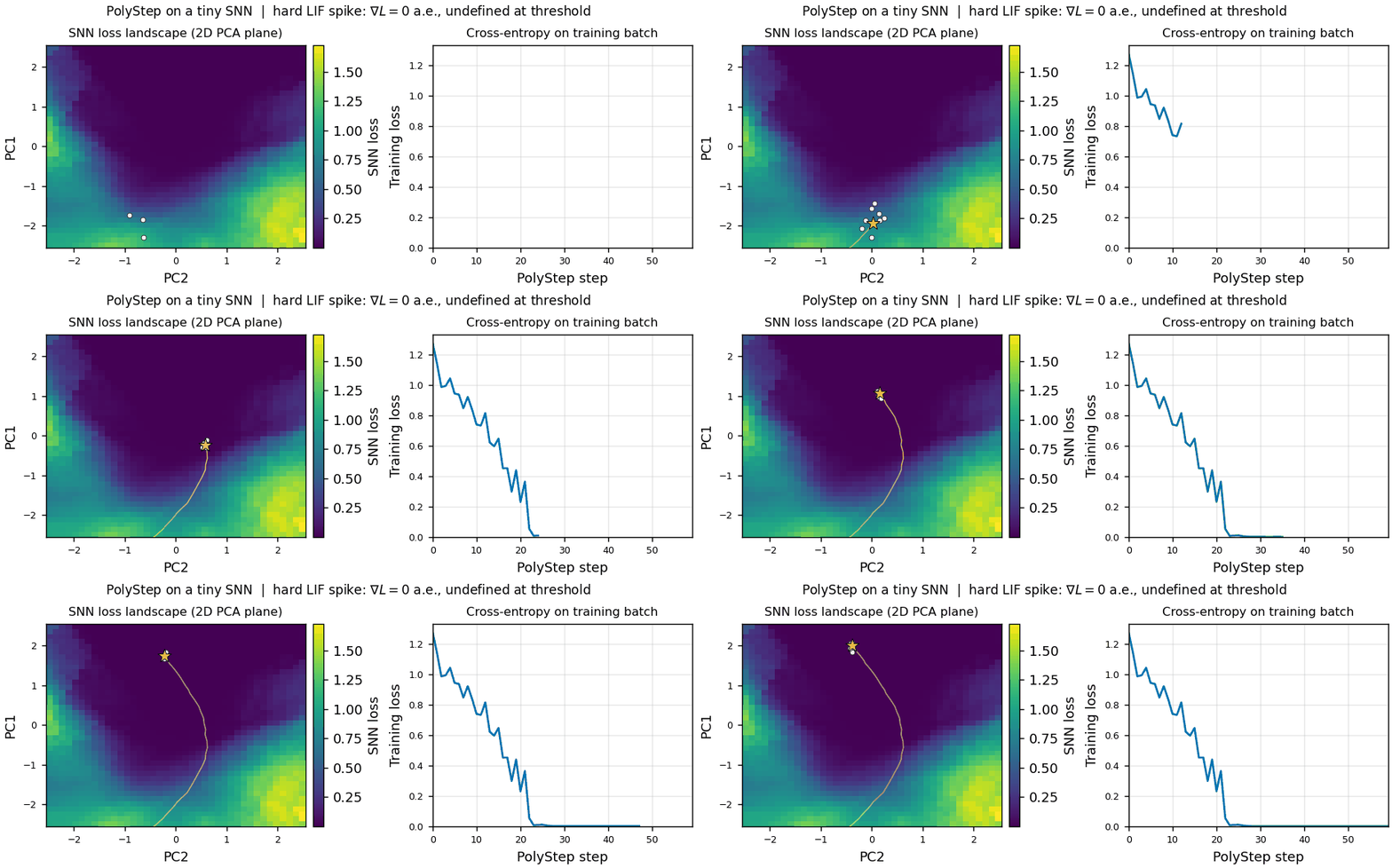
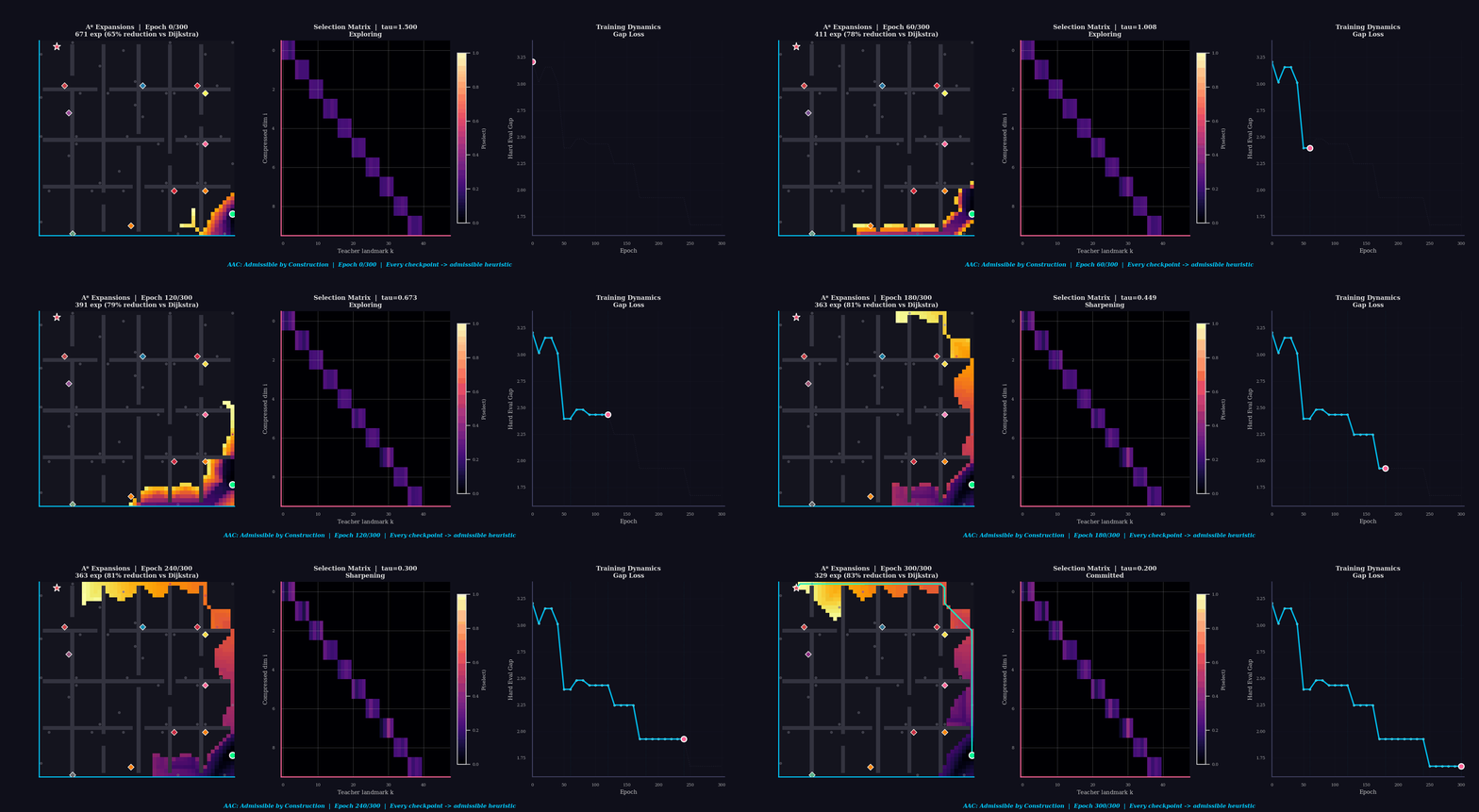
GTMP searches layered graphs with tensor operations; Anytime GTMP finds more paths and improves their cost as computation continues. MPOT uses optimal transport to optimize trajectories without gradients, while PolyStep applies optimal transport to train non-differentiable networks. AAC compresses graph-search heuristics while preserving admissibility.

GTMP · Anytime GTMP · MPOT · MTP · MPD · CLOT · PolyStep · AAC
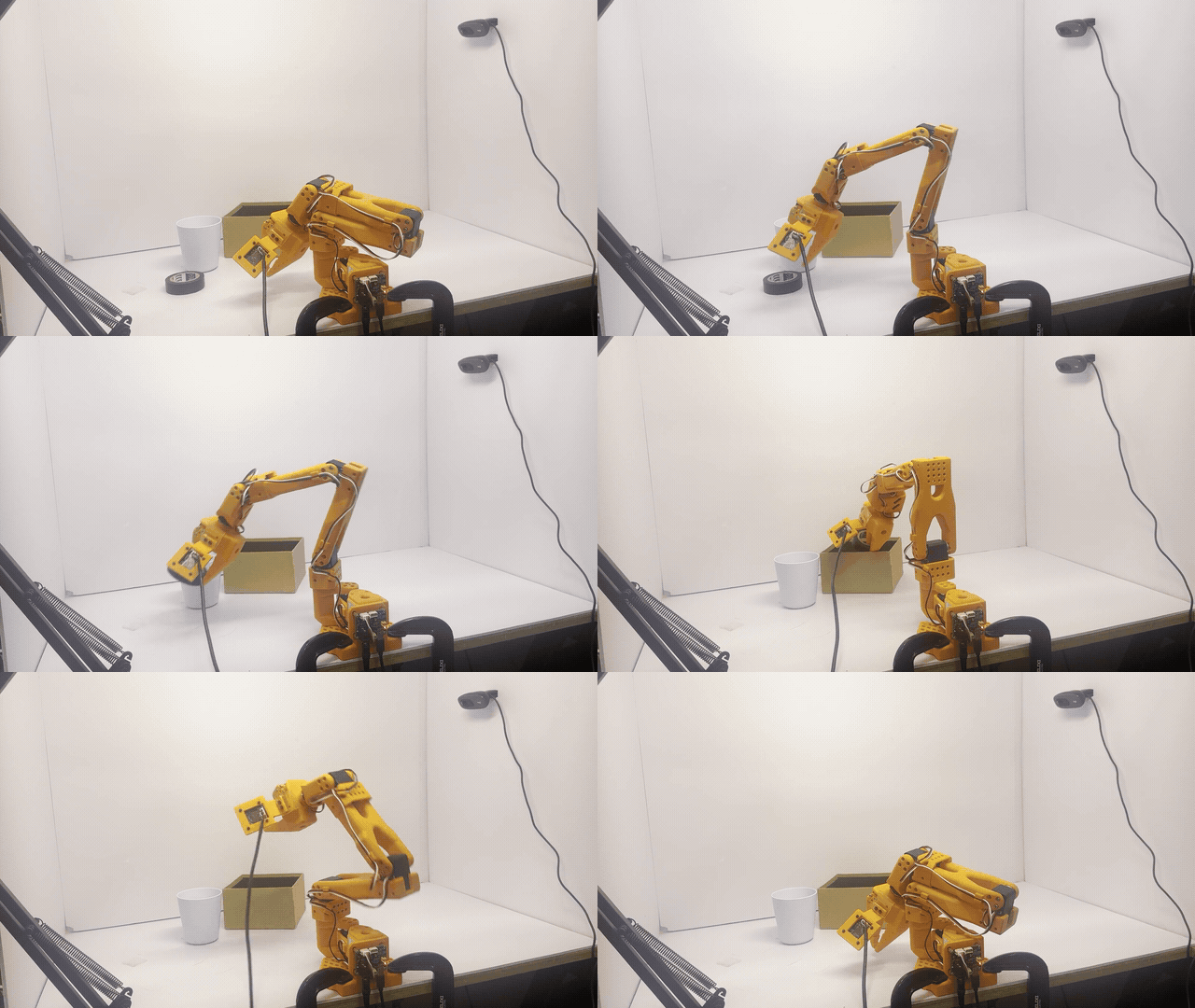
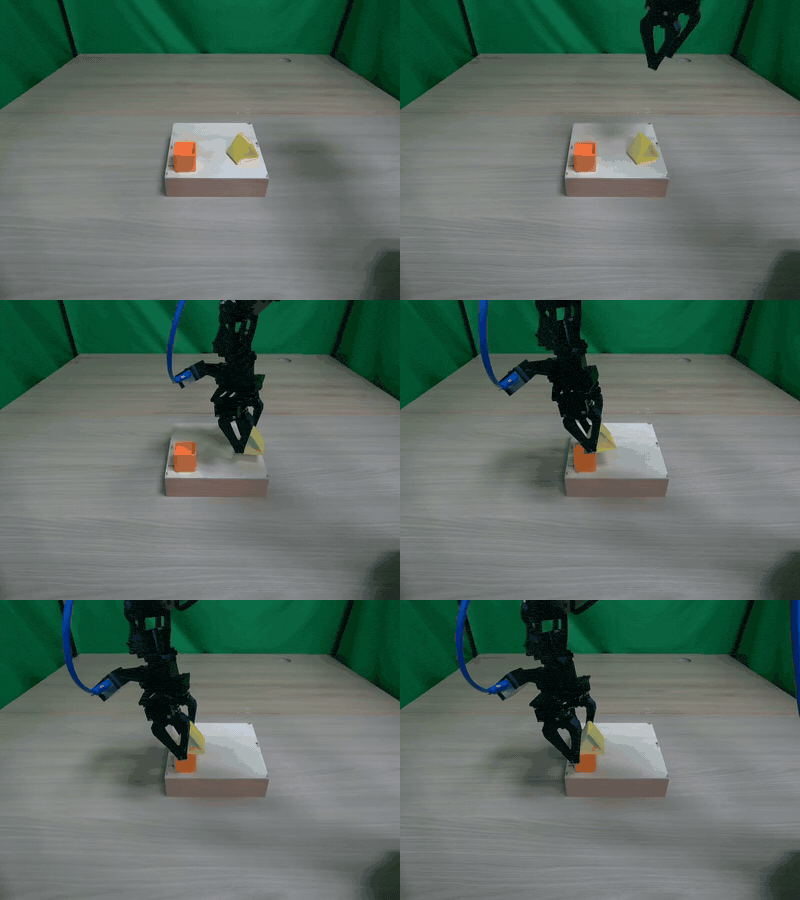
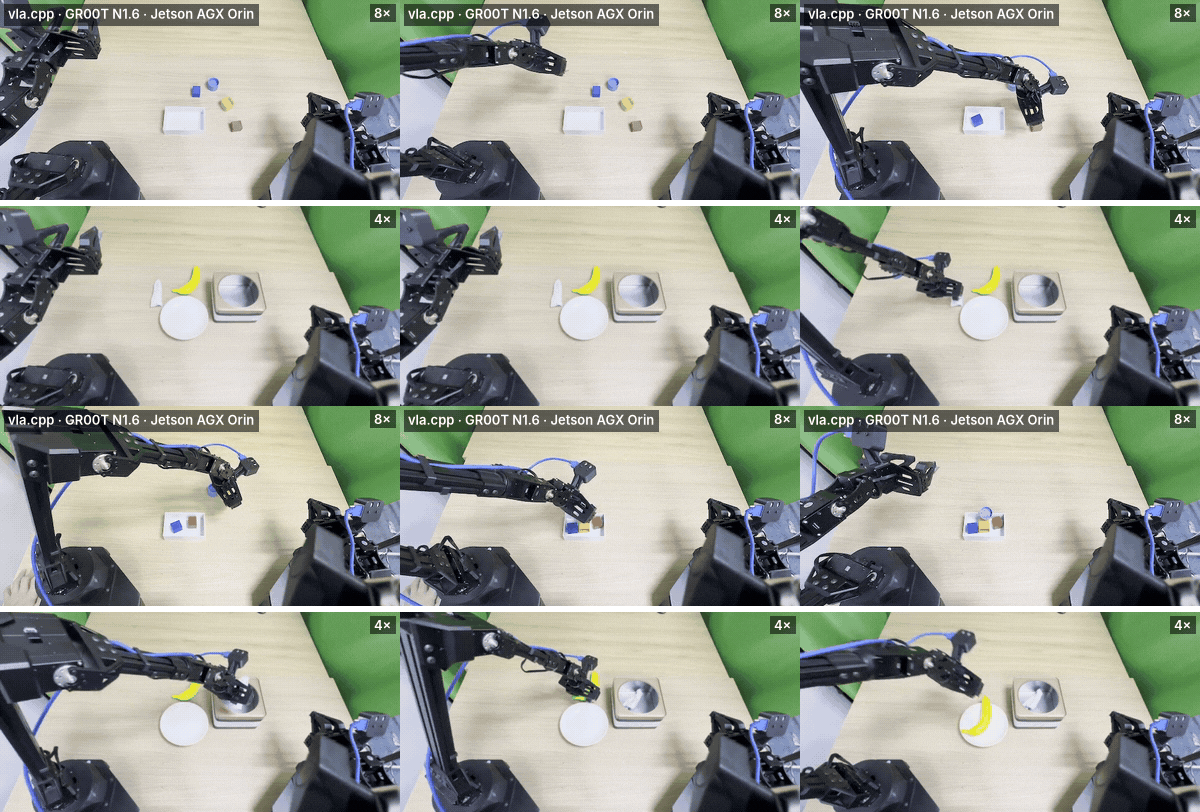
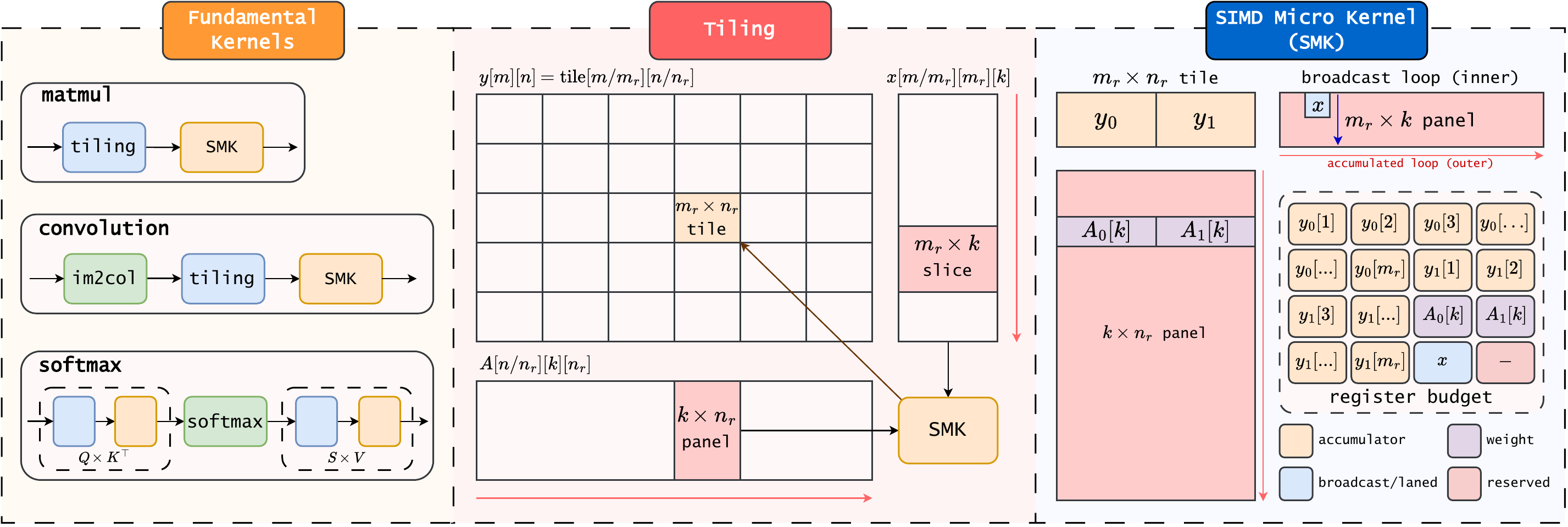
vla.simd routes linear layers, convolutions and attention through a shared, target-specific SIMD micro-kernel
vla.simd · shared kernels for CPU inference

02 / Efficient robot learning & systems

Scaling down robot foundation models

How much capability can we retain as we reduce the data, memory, and hardware budget?

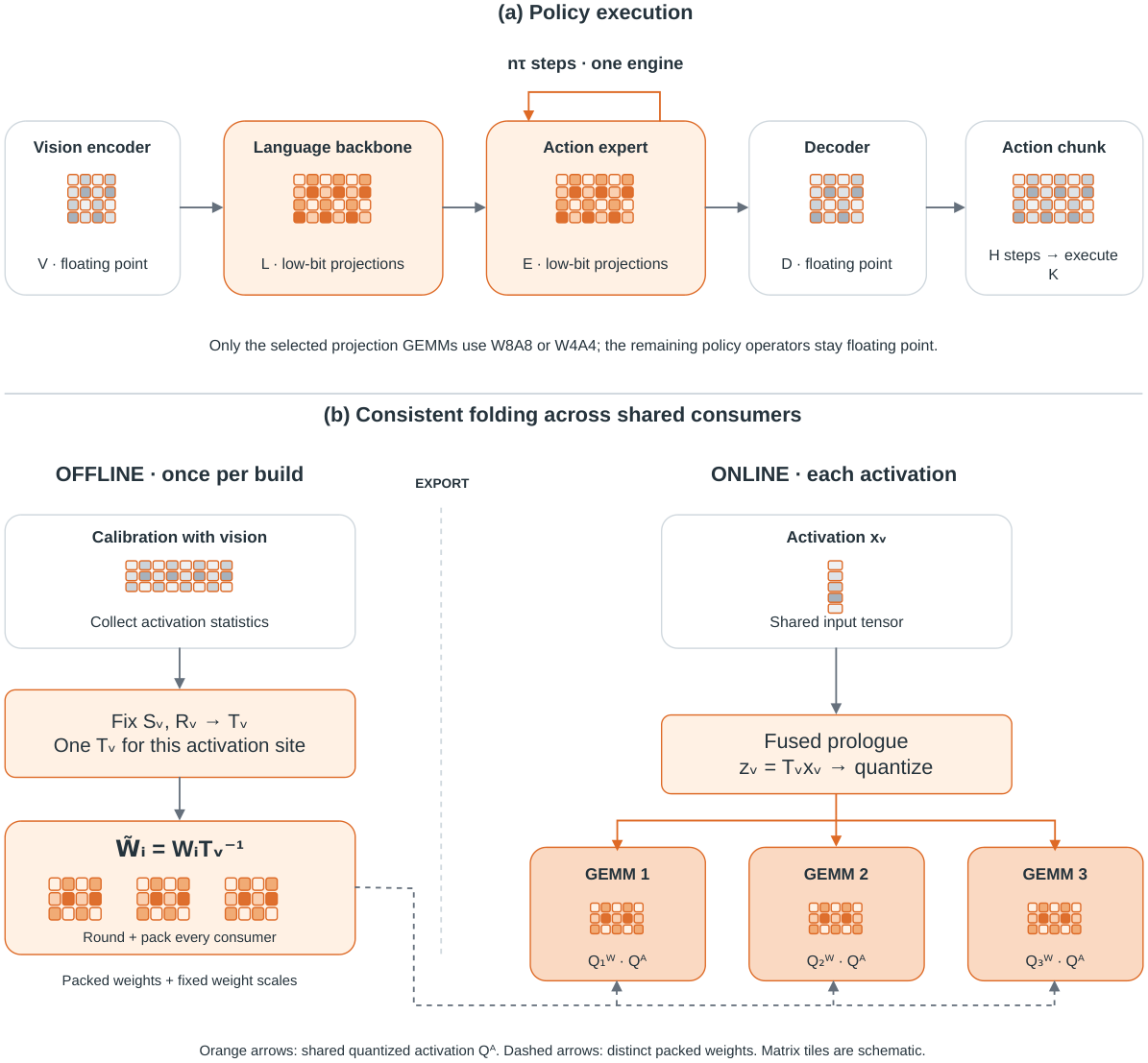
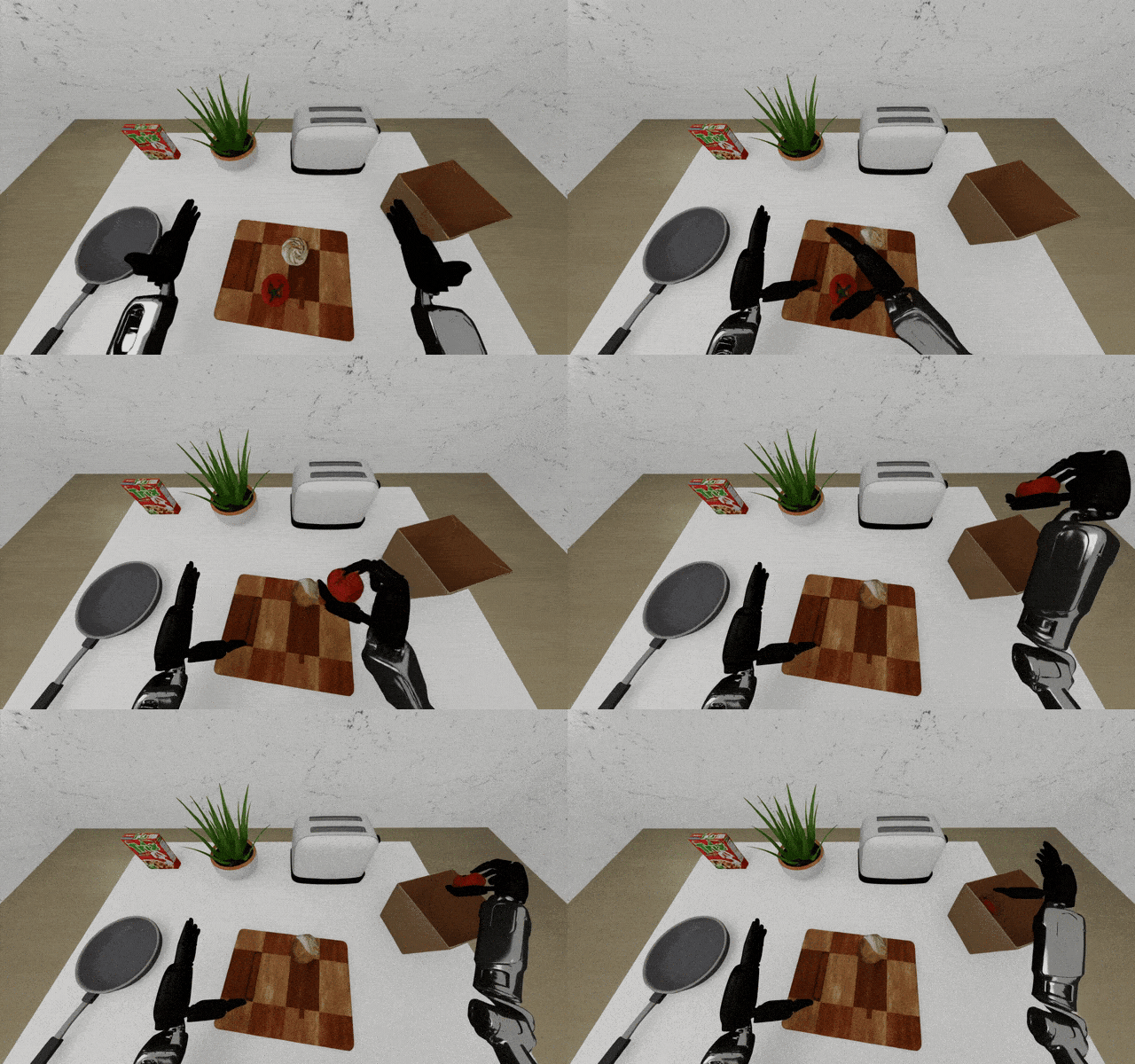
We compress and deploy vision-language-action (VLA) policies on affordable onboard computers. FoldQuantVLA quantizes the language backbone and action expert for native low-bit execution. vla.cpp provides a C++ inference runtime, and vla.simd uses shared SIMD kernels and computation reuse to run policies on CPUs, including a Raspberry Pi 5.

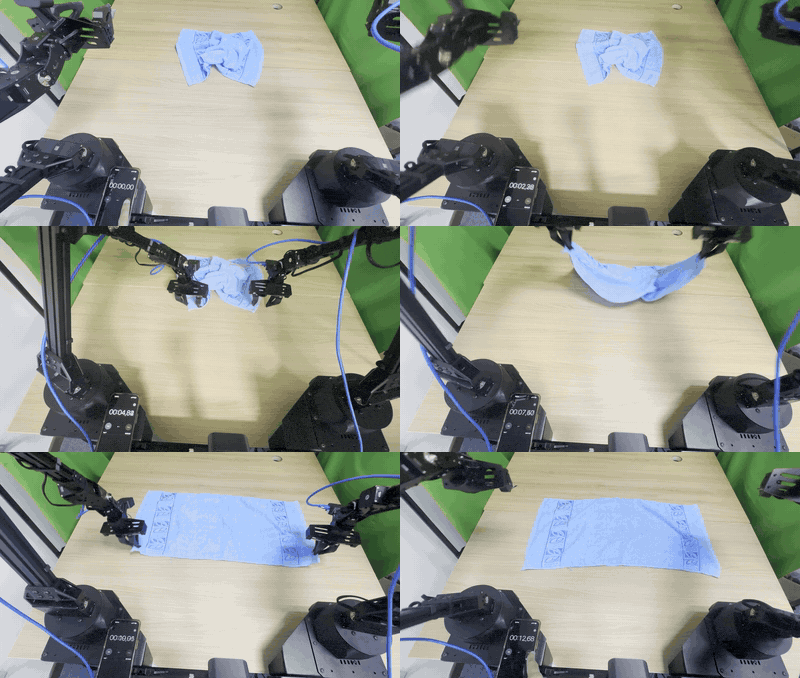
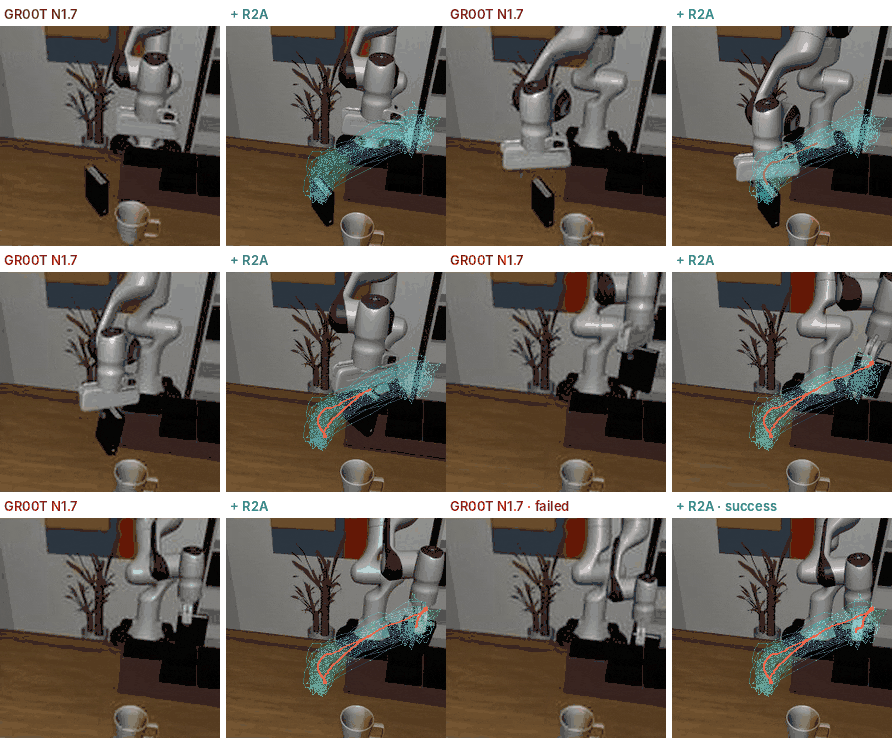
FOCA uses representations of future interactions and goals to adapt policies from fewer demonstrations. CLP removes redundant layers before fine-tuning, and PAINT selects initial noise to connect asynchronously generated action chunks. We measure the tradeoffs in task success, observation-to-action latency, memory, and action availability.

FoldQuantVLA · vla.simd · vla.cpp · CLP · FOCA · PAINT · EquiVLA · SDN

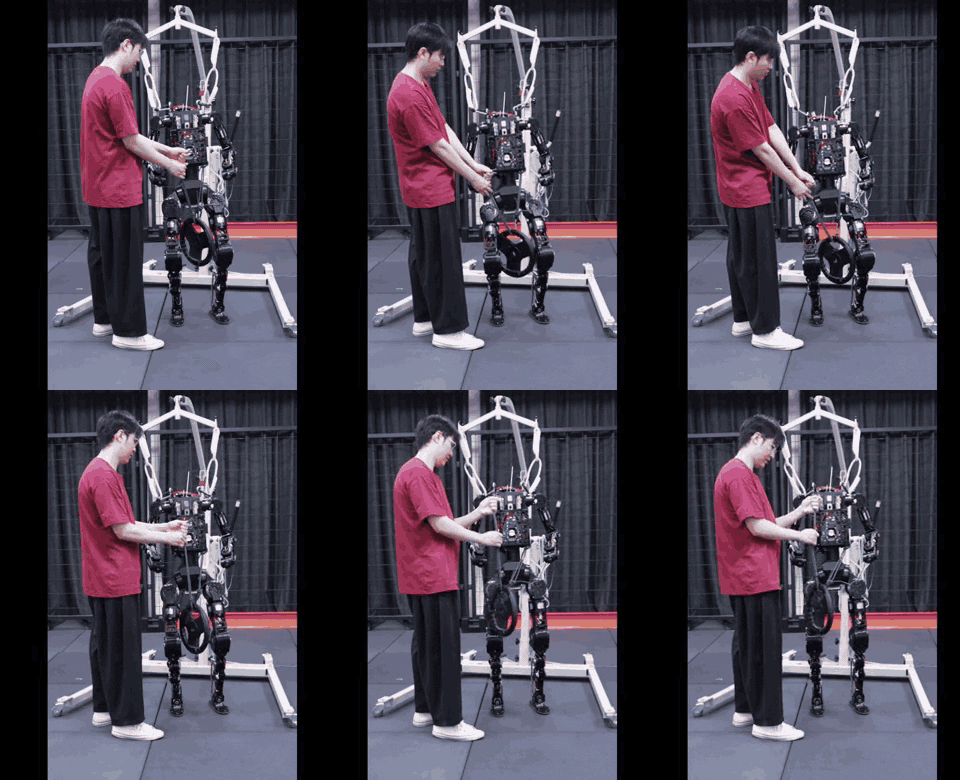
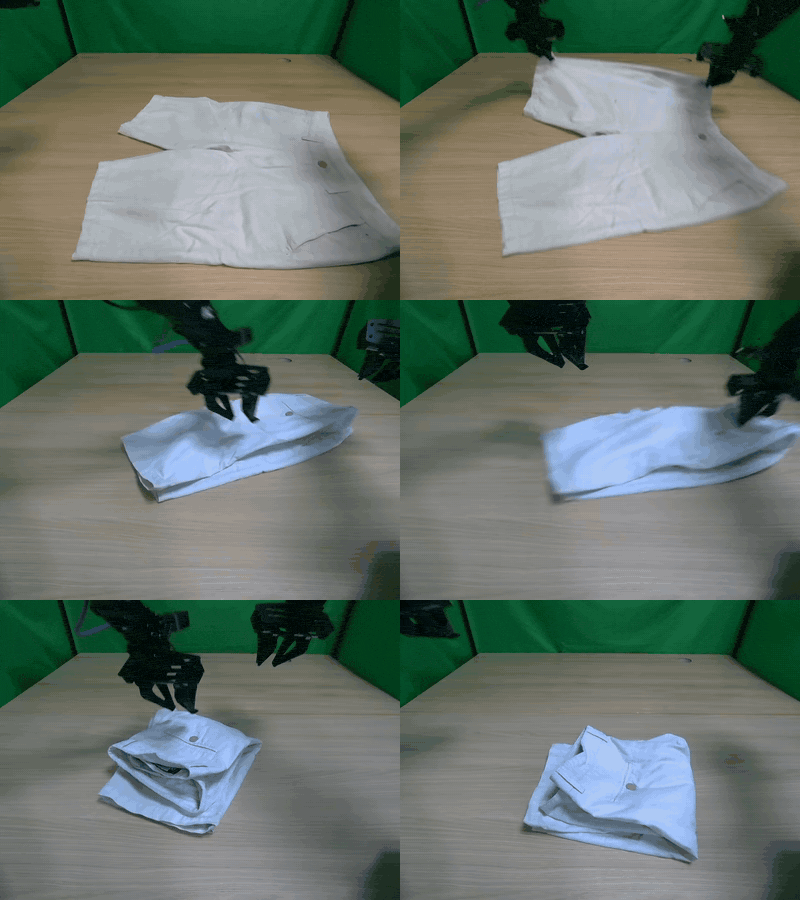
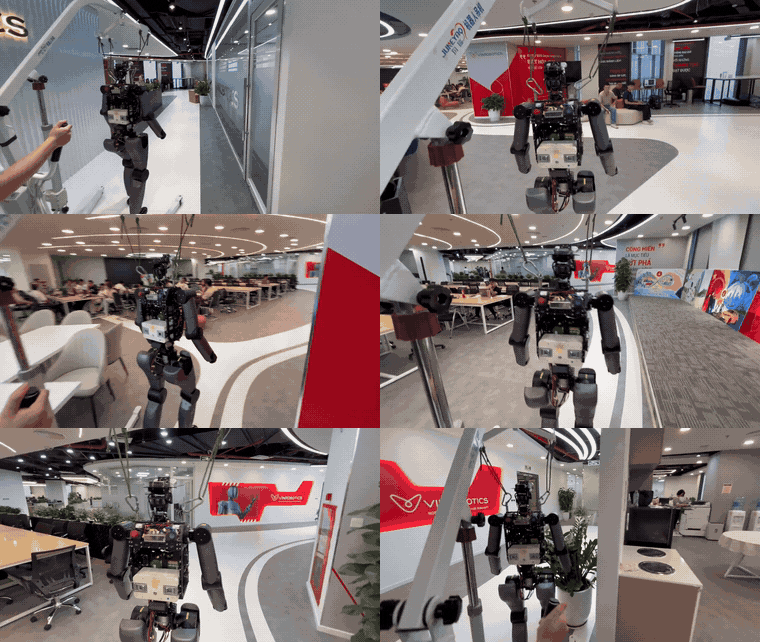
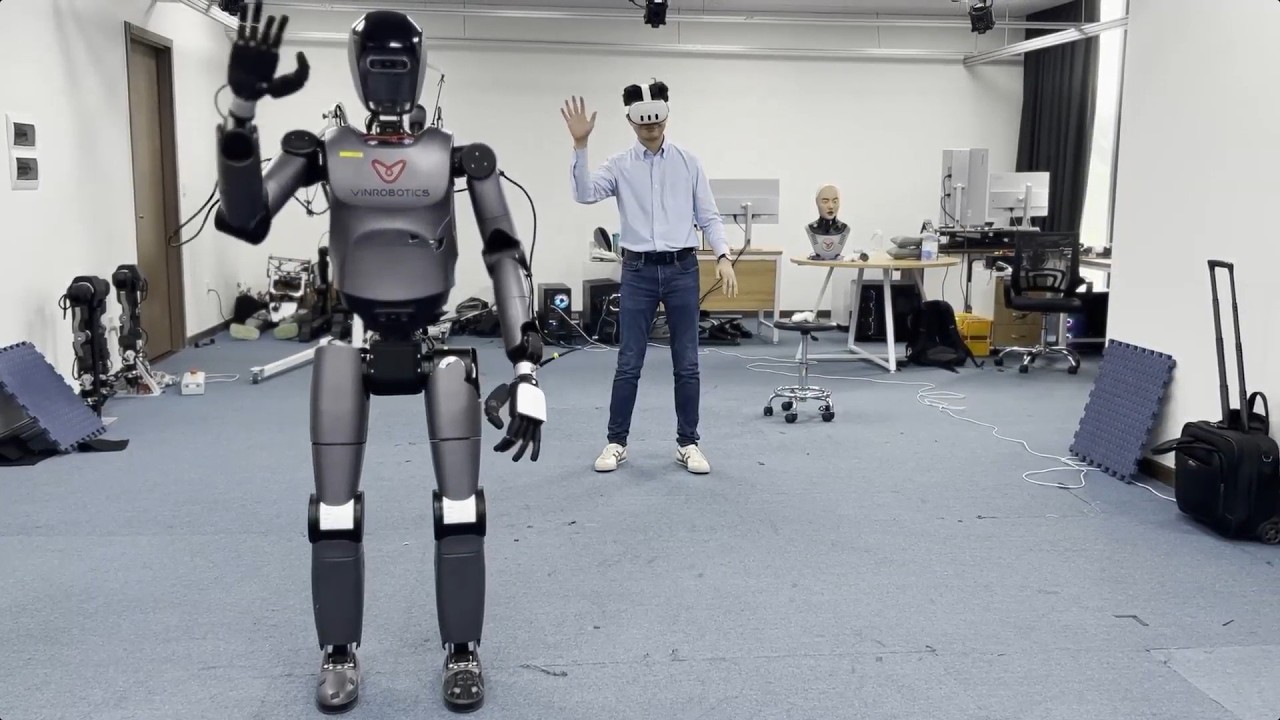
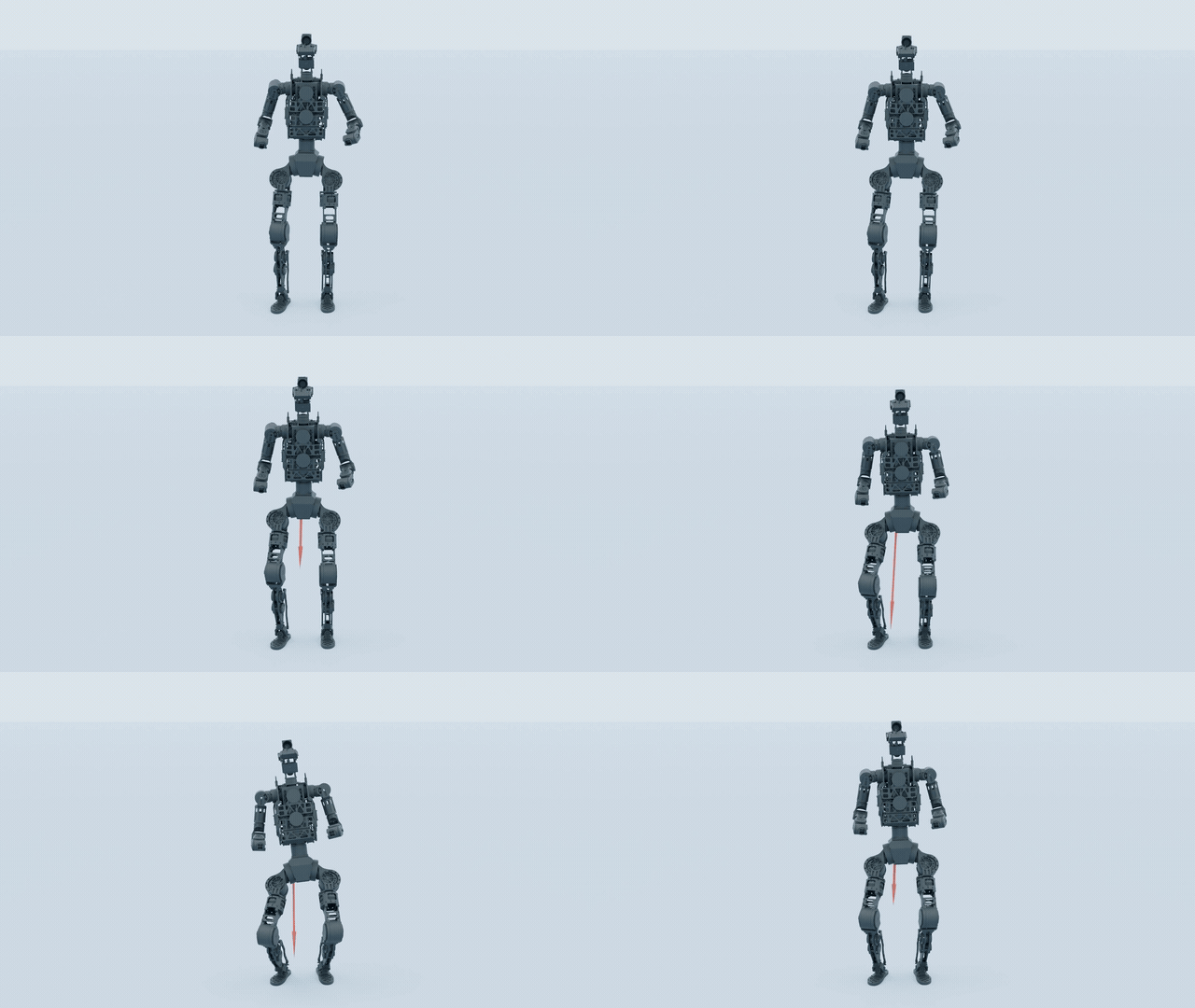
CompliantWBC: a 70 kg humanoid bends its knees under a person's downward pull, then rises again
CompliantWBC · whole-body response to a downward pull
03 / Humanoid control

Whole-body control through contact

How should a humanoid use its whole body to respond to contact and changing loads?

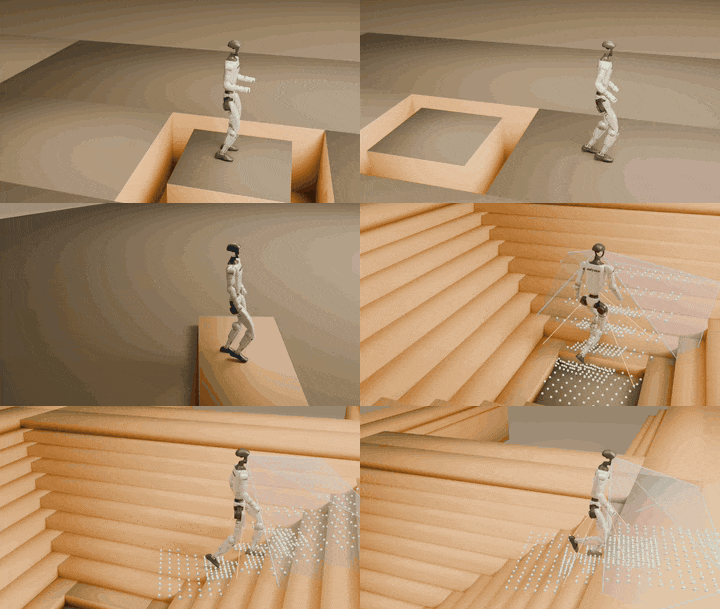
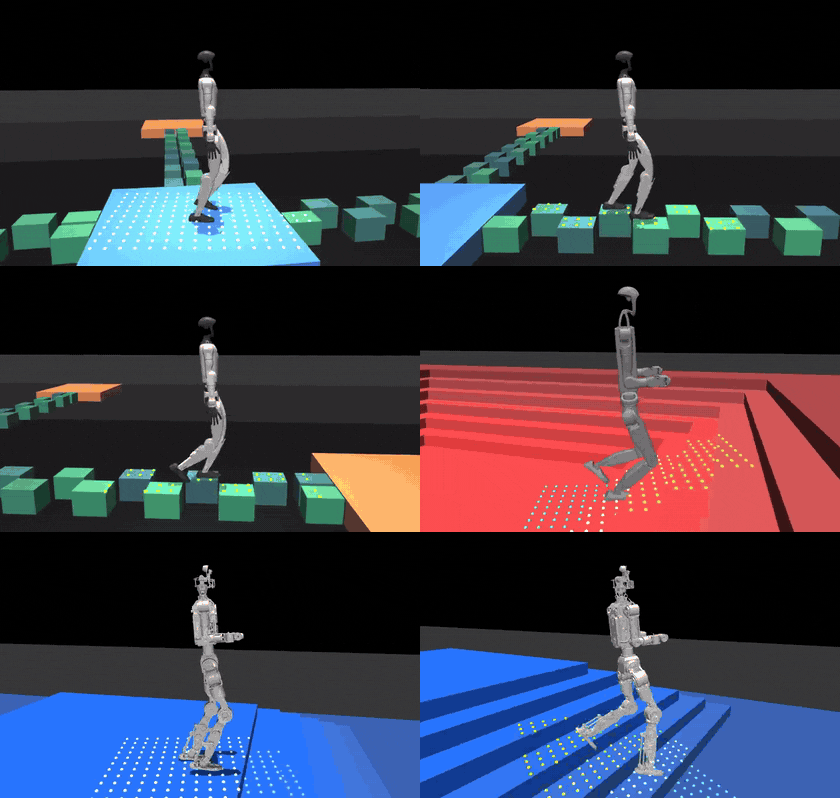
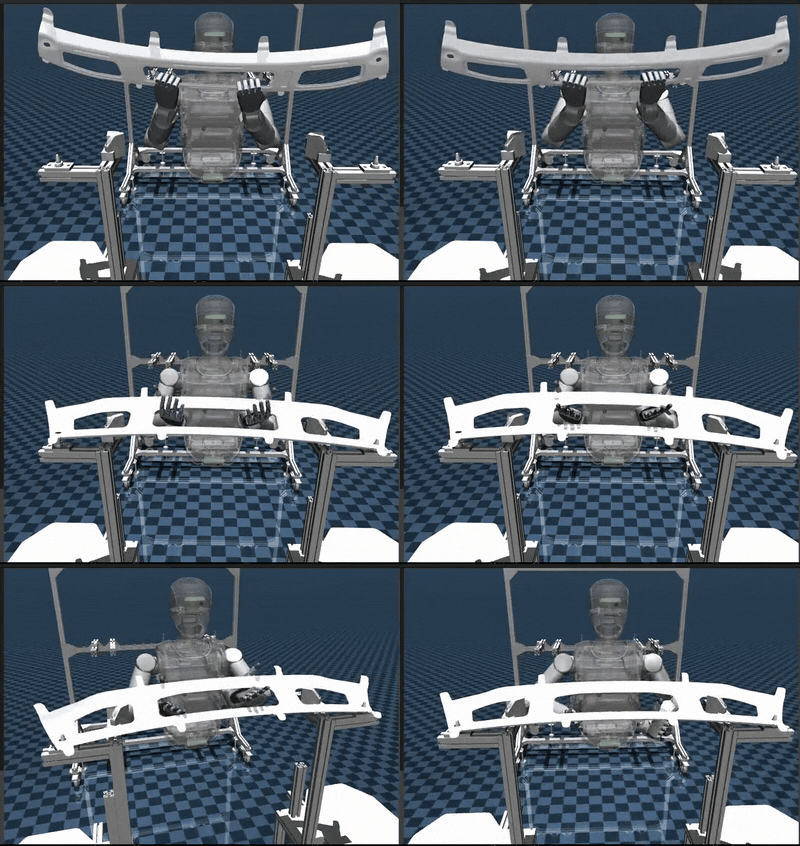
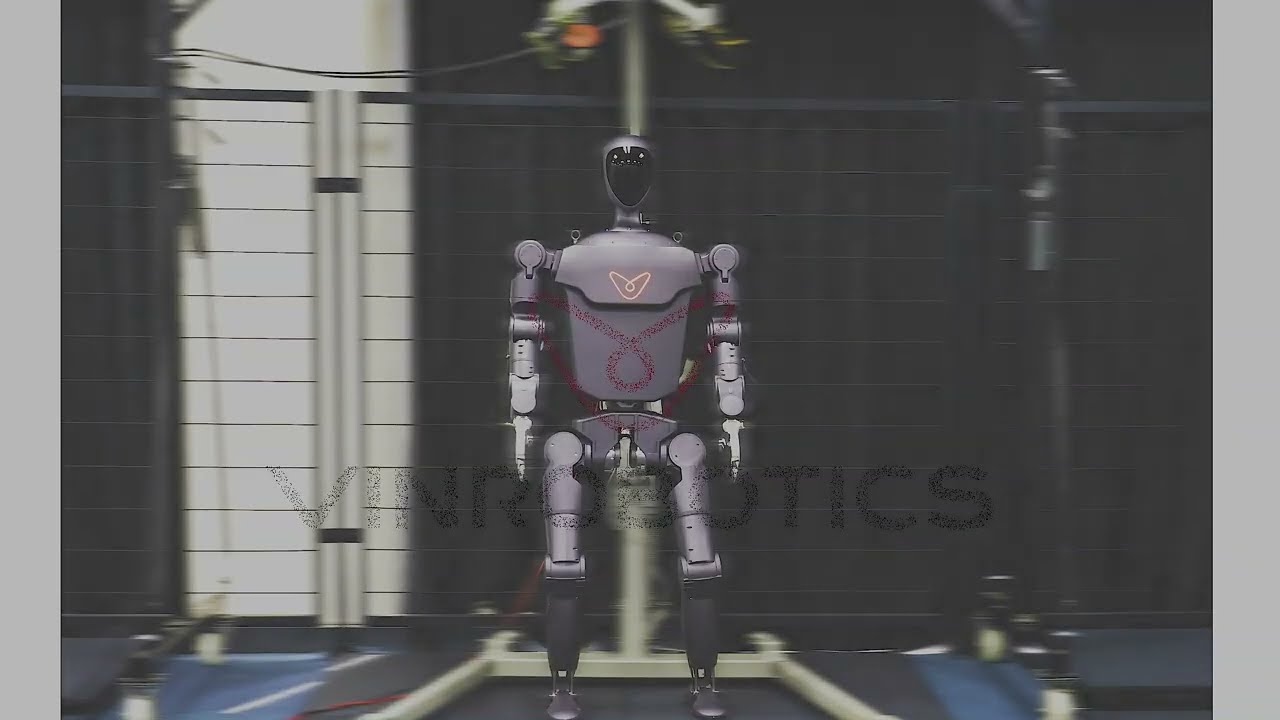
We develop controllers for 70–85 kg VinRobotics humanoids that adjust their motion to contact and changing loads. CompliantWBC estimates external forces from proprioception and adjusts impedance targets so the arms, torso, and legs respond together. TACT-ful combines GPU-parallel foothold planning with compliance training for walking over uneven terrain while carrying payloads.

CompliantWBC · TACT-ful · DoublyAware · CrossBFM · Hardware demos

A further research interest

Computational general relativity

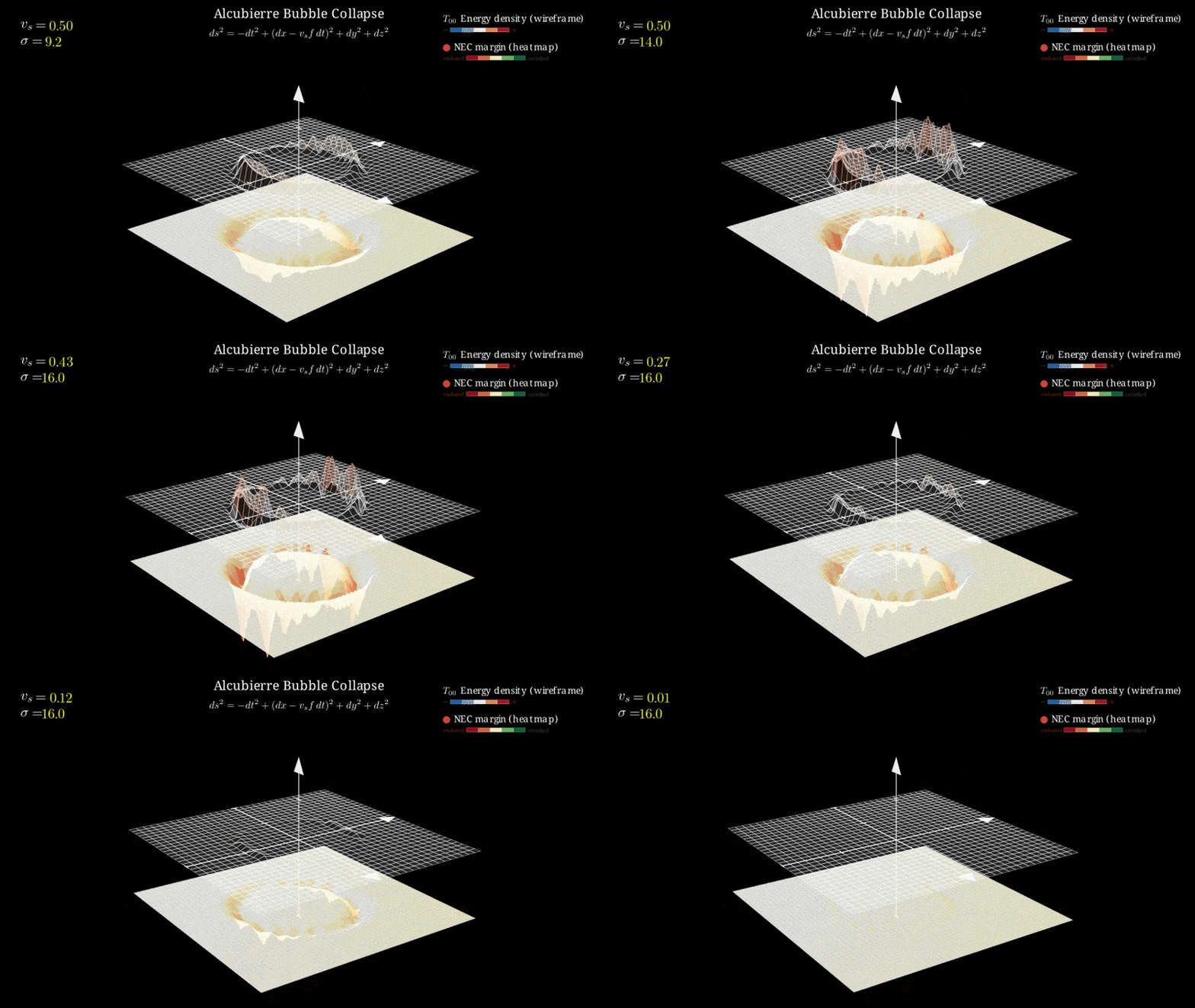
I also build numerical tools for general relativity. warpax uses vectorized auto-diff in JAX to compute spacetime curvature and check energy conditions, with matrix-inequality tests covering all observers at a point. The Kerr-flyby study simulates rocket trajectories to find when a rocket can extract energy from a rotating black hole and still escape. Pointwise energy-condition tests alone do not establish whether a warp drive is physically realizable.

warpax · CQG, accepted · Penrose extraction · Physical Review D

How the directions connect

We adapt algorithms to the hardware that runs them. GTMP batches graph search into tensor operations; FoldQuantVLA enables low-bit policy execution; vla.simd reuses kernels and computation across policy queries.

Our next goal is to combine these planners and policies with controllers that command both motion and compliance. We aim to train whole-body VLAs on contact-rich data and use planners to check their actions. Humanoid experiments test whether the resulting system responds accurately and quickly enough during contact.

The physics projects also turn mathematical models into numerical tests. warpax combines JAX auto-diff with energy-condition checks, while the Kerr-flyby study tests energy extraction under propulsion and escape constraints. As in planning and control, we state the assumptions under which each result holds.

In the news: warpax in Popular Mechanics (May 2026); VinRobotics' visit to DFKI; VinRobotics humanoids at ICRA 2026 in Báo Tin Tức.

Publications

Publications and manuscripts, with status shown for each. * co-first or co-last authors. A blue rule marks representative papers. See also Google Scholar.

Topic
Year

2026

  1. FoldQuantVLA: consistent folding and native low-bit policy execution

    Representative paper: FoldQuantVLA: Native Low-Bit Quantization of Vision-Language-Action Models via Consistent Folding

    Hung T. Ho, Khanh D. Nguyen, Quang D. Nguyen, Thanh Q. Duong, Ngan Le, Meng Guo, Vien A. Ngo, An Thai Le

    Quantizes VLA policies for native low-bit inference without retraining, using a consistent activation representation. W4A4 projections run 1.20–1.33× faster than floating-point TensorRT on Jetson AGX Orin; selective INT8 improves action fidelity and measured real-robot success.

    Preprint · 2026arXivProject page
    BibTeX
    @misc{ho2026foldquantvla,
      title         = {FoldQuantVLA: Native Low-Bit Quantization of Vision-Language-Action Models via Consistent Folding},
      author        = {Ho, Hung T. and Nguyen, Khanh D. and Nguyen, Quang D. and Duong, Thanh Q. and Le, Ngan and Guo, Meng and Ngo, Vien A. and Le, An T.},
      year          = {2026},
      eprint        = {2609.24433},
      archivePrefix = {arXiv},
      primaryClass  = {cs.RO},
      url           = {https://arxiv.org/abs/2609.24433}
    }
  2. vla.simd: shared SIMD micro-kernels for policy inference on CPUs

    Representative paper: vla.simd: Efficient CPU Inference for Language-Conditioned Manipulation

    Khanh D. Nguyen, Hoang M. Truong, An Thai Le

    Runs VLA policies on CPUs using shared SIMD kernels and computation reuse, with demonstrations on SO-101 and UR10e. On Raspberry Pi 5, IMPACT supplies 33.5 actions/s in fp32 after a 90 s thermal soak, measured as action output rather than feedback frequency.

    Preprint · 2026arXivProject page
    BibTeX
    @misc{nguyen2026vlasimd,
      title         = {vla.simd: Efficient CPU Inference for Language-Conditioned Manipulation},
      author        = {Nguyen, Khanh D. and Truong, Hoang M. and Le, An T.},
      year          = {2026},
      eprint        = {2609.24274},
      archivePrefix = {arXiv},
      primaryClass  = {cs.RO},
      url           = {https://arxiv.org/abs/2609.24274}
    }
  3. Representative paper: Training Non-Differentiable Networks via Optimal Transport PolyStep

    An Thai Le

    Trains networks with non-differentiable operations by using optimal transport to weight candidate parameter updates. Requires only forward evaluations, with comparisons against gradient-free methods at matched evaluation budgets.

    BibTeX
    @article{le2026training,
      title         = {Training Non-Differentiable Networks via Optimal Transport},
      author        = {Le, An T.},
      journal       = {Transactions on Machine Learning Research},
      issn          = {2835-8856},
      year          = {2026},
      url           = {https://openreview.net/forum?id=8mlcqTTMuU},
      eprint        = {2605.01928},
      archivePrefix = {arXiv},
      primaryClass  = {cs.LG}
    }
  4. Representative paper: Observer-robust energy condition verification for warp drive spacetimes warpax

    An Thai Le

    Uses vectorized auto-diff in JAX to check energy conditions in warp drive spacetimes. Combines 4×4 matrix inequalities over all observers at a point with interval bounds for certified decisions.

    Classical and Quantum GravityAccepted · 2026arXivCode
    BibTeX
    @article{le2026observer,
      title         = {Observer-robust energy condition verification for warp drive spacetimes},
      author        = {Le, An T.},
      journal       = {Classical and Quantum Gravity},
      year          = {2026},
      note          = {Accepted},
      eprint        = {2602.18023},
      archivePrefix = {arXiv},
      primaryClass  = {gr-qc}
    }
  5. Representative paper: Start Right, Arrive Right: Asynchronous Execution via Initial Noise Selection PAINT

    T.B. Ho, Q.T. Nguyen, T.L. Ha, G.B. Nguyen, V.T. Nguyen, L. Dinh, M.N. Vu, D.M.H. Nguyen, An Thai Le, V.A. Ngo

    Selects initial noise through flow inversion to smoothly connect action chunks while the robot keeps moving. Requires no retraining or inference-time gradients; evaluated on 12 simulated benchmarks and 6 real manipulation tasks.

    BibTeX
    @inproceedings{ho2026start,
      title         = {Start Right, Arrive Right: Asynchronous Execution via Initial Noise Selection},
      author        = {Ho, Trong-Bao and Nguyen, Quang-Tan and Ha, Thien-Loc and Nguyen, Gia-Binh and Nguyen, Viet-Thanh and Dinh, Long and Vu, Minh N. and Nguyen, Duy M. H. and Le, An Thai and Ngo, Vien Anh},
      booktitle     = {Conference on Robot Learning (CoRL)},
      year          = {2026},
      eprint        = {2606.19774},
      archivePrefix = {arXiv},
      primaryClass  = {cs.RO},
      url           = {https://arxiv.org/abs/2606.19774}
    }
  6. Representative paper: FOCA: Future-Oriented Conditioning for Data-Efficient Vision-Language-Action Adaptation

    D.M. Nguyen*, N.T. Diep*, G.B. Nguyen*, T.B. Ho, D.T. Le, Q.T. Nguyen, T.L. Ha, V.N. Tran, B. Thach, X.N. Tran, T.A. Tran, A. Habuda, P.L. Møller, T.N. Le, D. Sonntag, M. Niepert, K.D. Doan, V.N. Duong, H. Ngo, M.N. Vu, D.M.H. Nguyen*, An Thai Le*, V.A. Ngo*

    Adapts VLA policies from few demonstrations using representations of future interactions and goals. Achieves 95.7% success on LIBERO with 20 demonstrations per task, with further evaluations in RoboCasa and on real robots.

    BibTeX
    @inproceedings{nguyen2026foca,
      title         = {{FOCA}: Future-Oriented Conditioning for Data-Efficient Vision-Language-Action Adaptation},
      author        = {Nguyen, Duc Minh and Diep, Nghiem Tuong and Nguyen, Binh Gia and Ho, Trong-Bao and Le, Doanh and Nguyen, Tan Q. and Ha, Thien-Loc and Tran, Nhiem and Thach, Bao and Tran, Nhat X. and Tran, Tuan A. and Habuda, Artur and M{\o}ller, Philip Lund and Le, Tran Nguyen and Sonntag, Daniel and Niepert, Mathias and Doan, Khoa D. and Duong, Vu and Ngo, Hung and Vu, Minh N. and Nguyen, Duy M. H. and Le, An Thai and Ngo, Vien Anh},
      booktitle     = {International Conference on Machine Learning (ICML)},
      series        = {Proceedings of Machine Learning Research},
      volume        = {306},
      publisher     = {PMLR},
      year          = {2026},
      eprint        = {2606.20867},
      archivePrefix = {arXiv},
      primaryClass  = {cs.CV},
      url           = {https://arxiv.org/abs/2606.20867}
    }
  7. CLOT: Multi-Robot Motion Planning via Collaborative Optimal Transport under Signal Temporal Logic Tasks

    Y. Zhang, Y. Zhang, An Thai Le, M. Guo

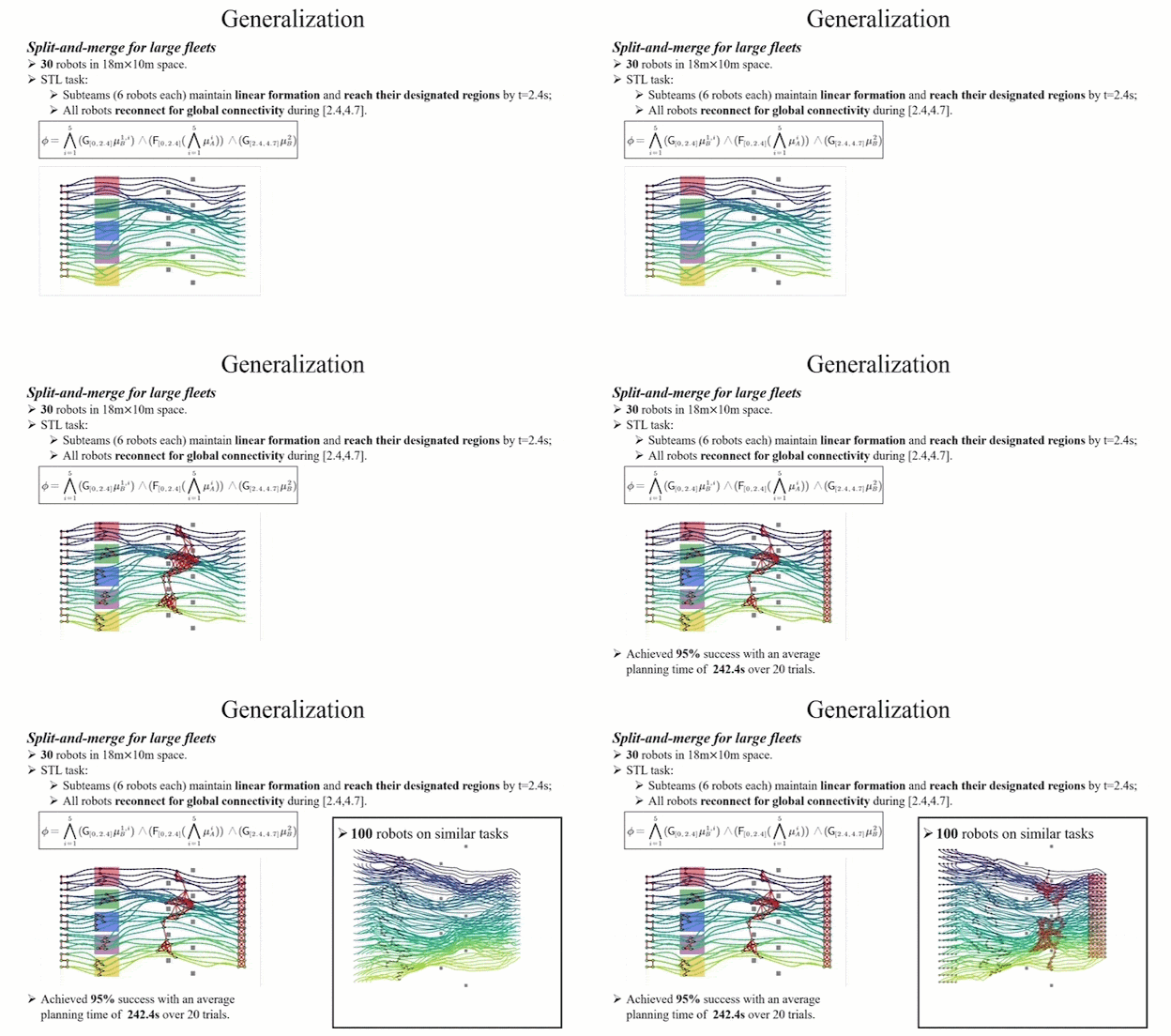
    Uses collaborative optimal transport to plan multi-robot trajectories for tasks specified in signal temporal logic. Updates trajectories without gradients; evaluated in simulation and on hardware.

    ICRA 2026PDF
    BibTeX
    @inproceedings{zhang2026clot,
      title     = {{CLOT}: Multi-robot Motion Planning via Collaborative Optimal Transport under Signal Temporal Logic Tasks},
      author    = {Zhang, Ying and Zhang, Yunyi and Le, An T. and Guo, Meng},
      booktitle = {IEEE International Conference on Robotics and Automation (ICRA)},
      year      = {2026},
      url       = {https://mengguo.github.io/personal_site/papers/pdf/zhang2026clot.pdf}
    }
  8. StructSAM: Structure- and Spectrum-Preserving Token Merging for Segment Anything Models

    D.M.H. Nguyen, T.A. Tran, D. Nguyen, S. Xie, T.Q. Nguyen, M.T.N. Truong, D. Palenicek, An Thai Le, M. Barz, E. Hannus, T. Nguyen, T. Dam, T.N. Le, N. Le, M. Vu, K. Doan, V. Ngo, P. Xie, J. Zou, D. Sonntag, J. Peters, M. Niepert

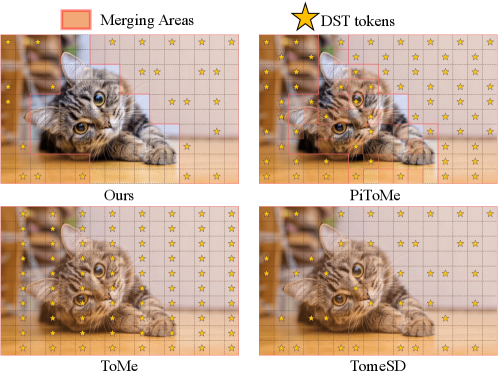
    Reduces Segment Anything's encoder computation by merging redundant tokens while preserving boundaries and prompt regions. Evaluates the resulting tradeoff in segmentation accuracy.

    ICML 2026 Workshop (AdaptFM)arXivOpenReviewWorkshop
    BibTeX
    @inproceedings{nguyen2026structsam,
      title         = {{StructSAM}: Structure- and Spectrum-Preserving Token Merging for Segment Anything Models},
      author        = {Nguyen, Duy M. H. and Tran, Tuan A. and Nguyen, Duong and Xie, Siwei and Nguyen, Trung Q. and Truong, Mai T. N. and Palenicek, Daniel and Le, An T. and Barz, Michael and Hannus, Eric and Nguyen, TrungTin and Dam, Tuan and Le, Tran Nguyen and Le, Ngan and Vu, Minh and Doan, Khoa and Ngo, Vien and Xie, Pengtao and Zou, James and Sonntag, Daniel and Peters, Jan and Niepert, Mathias},
      booktitle     = {ICML 2026 Workshop on Resource-Adaptive Foundation Model Inference (AdaptFM)},
      year          = {2026},
      url           = {https://openreview.net/forum?id=K41rNB0F8j},
      eprint        = {2603.07307},
      archivePrefix = {arXiv},
      primaryClass  = {cs.CV}
    }
  9. Rarity of rocket-driven Penrose extraction in Kerr spacetime Penrose rocket

    An Thai Le

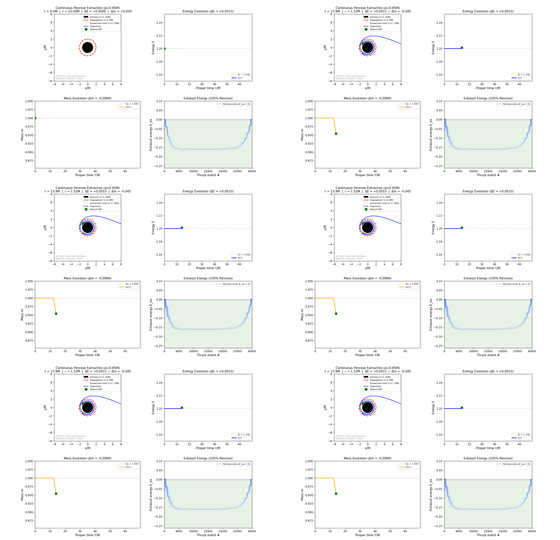
    Simulates 320,000 rocket flybys around rotating black holes to test energy extraction and escape. Successful cases are rare in the broad scans and concentrated at high black-hole spin and relativistic exhaust speeds.

    Phys. Rev. D 2026DOIarXivCode
    BibTeX
    @article{le2026rarity,
      title         = {Rarity of rocket-driven {Penrose} extraction in {Kerr} spacetime},
      author        = {Le, An T.},
      journal       = {Physical Review D},
      volume        = {113},
      number        = {12},
      pages         = {124036},
      year          = {2026},
      month         = jun,
      doi           = {10.1103/f3jn-7wcp},
      eprint        = {2601.19616},
      archivePrefix = {arXiv},
      primaryClass  = {astro-ph.HE}
    }
  10. DoublyAware: Dual Planning and Policy Awareness for Temporal Difference Learning in Humanoid Locomotion

    Khang Nguyen, An Thai Le, Jan Peters, Minh Nhat Vu

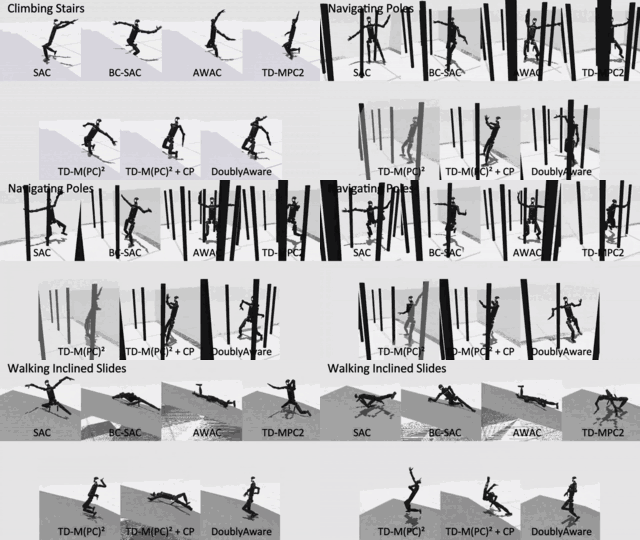
    Handles planning and policy uncertainty separately in TD-MPC: conformal filtering screens candidate trajectories, and a group-relative trust region constrains policy updates. Evaluated on a simulated H1-2 humanoid.

    IEEE RA-L 2026DOIarXiv
    BibTeX
    @article{nguyen2026doublyaware,
      title         = {{DoublyAware}: Dual Planning and Policy Awareness for Temporal Difference Learning in Humanoid Locomotion},
      author        = {Nguyen, Khang and Le, An Thai and Peters, Jan and Vu, Minh Nhat},
      journal       = {IEEE Robotics and Automation Letters},
      volume        = {11},
      number        = {2},
      pages         = {2162--2169},
      year          = {2026},
      doi           = {10.1109/LRA.2025.3648611},
      eprint        = {2506.12095},
      archivePrefix = {arXiv},
      primaryClass  = {cs.RO}
    }
  11. Anytime Global Tensor Motion Planning Anytime GTMP

    S. Coumar, An Thai Le*, Z. Kingston*

    Extends tensor motion planning to black-box local planners, discovering more paths and improving their cost as computation continues. Provides asymptotic optimality under stated clearance and sampling assumptions.

    Under review (2026)arXivCode
    BibTeX
    @misc{coumar2026anytime,
      title         = {Anytime Global Tensor Motion Planning},
      author        = {Coumar, Sai and Le, An T. and Kingston, Zachary},
      year          = {2026},
      eprint        = {2608.25830},
      archivePrefix = {arXiv},
      primaryClass  = {cs.RO},
      url           = {https://arxiv.org/abs/2608.25830}
    }
  12. Representative paper: CompliantWBC: Whole-Body Compliance for Heavy Humanoids via Force Latent Estimation and Residual Impedance Targets

    T.D. Do*, C.T. Trinh*, T.D. Phuong, T.D. Dang, C. Le, T. Ly, V.A. Ngo, An Thai Le

    Estimates external forces from proprioception and adjusts impedance targets so a 70 kg humanoid yields to contact across its body. The analytical passivity guarantee is local and assumes fixed stiffness.

    Under review (2026)Project pagePDF
    BibTeX
    @misc{do2026compliantwbc,
      title        = {{CompliantWBC}: Whole-Body Compliance for Heavy Humanoids via Force Latent Estimation and Residual Impedance Targets},
      author       = {Do, Tan-Dzung and Trinh, Cuc T. and Phuong, Tuan Dat and Dang, Truong-Duy and Le, Chien and Ly, Thanh and Ngo, Vien Anh and Le, An T.},
      year         = {2026},
      howpublished = {\url{https://compliantwbc.github.io/paper/compliant_wbc.pdf}},
      note         = {Under review}
    }
  13. TACT-ful: Multi-Channel Terrain Affordance and Compliance Training for Payload-Robust Perceptive Humanoid Locomotion

    T. Ly*, T.D. Dang*, C. Le, T.D. Do, T.D. Phuong, C.T. Trinh, V.A. Ngo, An Thai Le

    Combines GPU-parallel foothold search with compliance training to help humanoids walk over uneven terrain with changing payloads. Evaluated quantitatively in simulation, with qualitative hardware demonstrations.

    Under review (2026)arXivProject page
    BibTeX
    @misc{ly2026tactful,
      title         = {{TACT}-ful: Multi-Channel Terrain Affordance and Compliance Training for Payload-Robust Perceptive Humanoid Locomotion},
      author        = {Ly, Thanh and Dang, Truong-Duy and Le, Chien and Do, Tan-Dzung and Phuong, Tuan Dat and Trinh, Cuc T. and Ngo, Vien Anh and Le, An T.},
      year          = {2026},
      eprint        = {2606.20645},
      archivePrefix = {arXiv},
      primaryClass  = {cs.RO},
      url           = {https://arxiv.org/abs/2606.20645}
    }
  14. CrossBFM: Distilling a Shared Latent Behavior Space Across Humanoid Embodiments

    T.D. Do*, T.D. Phuong*, C.T. Trinh, V.A. Ngo, An Thai Le

    Distills humanoid behaviors into a shared latent space, then decodes that motion representation for robots with different body shapes.

    Under review (2026)
    BibTeX
    @misc{do2026crossbfm,
      title  = {{CrossBFM}: Distilling a Shared Latent Behavior Space Across Humanoid Embodiments},
      author = {Do, Tan-Dzung and Phuong, Tuan Dat and Trinh, Cuc T. and Ngo, Vien Anh and Le, An T.},
      year   = {2026},
      note   = {Under review}
    }
  15. EquiVLA: A General Framework for Rotationally Equivariant Vision-Language-Action Models

    T.L. Ha*, Q.T. Nguyen*, T.B. Ho*, L. Dinh, M.D. Nguyen, G.B. Nguyen, T.Q. Pham, M.N. Vu, D.M.H. Nguyen, An Thai Le, V.A. Ngo

    Adds rotational equivariance to pretrained VLAs so actions follow rotations of the input. Perception is approximately equivariant and the action head is exactly equivariant; evaluated with GR00T N1.5 on LIBERO.

    Under review (2026)arXivProject page
    BibTeX
    @misc{ha2026equivla,
      title         = {{EquiVLA}: A General Framework for Rotationally Equivariant Vision-Language-Action Models},
      author        = {Ha, Thien-Loc and Nguyen, Quang-Tan and Ho, Trong-Bao and Dinh, Long and Nguyen, Minh Duc and Nguyen, Gia-Binh and Pham, Tri Quang and Vu, Minh N. and Nguyen, Duy M. H. and Le, An Thai and Ngo, Vien Anh},
      year          = {2026},
      eprint        = {2606.19784},
      archivePrefix = {arXiv},
      primaryClass  = {cs.RO},
      url           = {https://arxiv.org/abs/2606.19784}
    }
  16. vla.cpp: A Unified Inference Runtime for Vision-Language-Action Models

    K.D. Nguyen, H.T. Ho, C.T. Nguyen, T.Q. Duong, L.D. Le, D.M.H. Nguyen, V.A. Ngo, An Thai Le

    Runs eleven VLA models in a C++ runtime for onboard inference. BitVLA completes 200/200 simulated LIBERO-Object episodes with inference on an 8 GB Jetson Orin Nano in the reported evaluation.

    Under review (2026)arXivProject pageCode
    BibTeX
    @misc{nguyen2026vlacpp,
      title         = {{vla.cpp}: A Unified Inference Runtime for Vision-Language-Action Models},
      author        = {Nguyen, Khanh D. and Ho, Hung T. and Nguyen, Chinh T. and Duong, Thanh Q. and Le, Linh D. and Nguyen, Duy M. H. and Ngo, Vien A. and Le, An T.},
      year          = {2026},
      eprint        = {2606.08094},
      archivePrefix = {arXiv},
      primaryClass  = {cs.RO},
      url           = {https://arxiv.org/abs/2606.08094}
    }
  17. Finetuning Vision-Language-Action Models Requires Fewer Layers Than You Think CLP

    G.B. Nguyen, T.B. Ho, T.L. Ha, K. Vo, P.L. Møller, Q.T. Nguyen, L. Dinh, T.M. Luu, T. Dam, V. Duong, T. Le, N.D.Q. Bui, M. Vu, T.N. Le, An Thai Le, N. Le, D. Sonntag, J. Zou, J. Peters, D.M.H. Nguyen, V.A. Ngo

    Prunes redundant VLA layers before fine-tuning using a single representation-similarity pass. Measures the savings in model depth and training time against task performance.

    Under review (2026)arXivProject page
    BibTeX
    @misc{nguyen2026finetuning,
      title         = {Finetuning Vision-Language-Action Models Requires Fewer Layers Than You Think},
      author        = {Nguyen, Gia-Binh and Ho, Trong-Bao and Ha, Thien-Loc and Vo, Khoa and M{\o}ller, Philip Lund and Nguyen, Quang T. and Dinh, Long and Luu, Tung M. and Dam, Tuan and Duong, Vu and Le, Trung and Bui, Nghi D. Q. and Vu, Minh and Le, Tran Nguyen and Le, An Thai and Le, Ngan and Sonntag, Daniel and Zou, James and Peters, Jan and Nguyen, Duy M. H. and Ngo, Vien Anh},
      year          = {2026},
      eprint        = {2606.20246},
      archivePrefix = {arXiv},
      primaryClass  = {cs.RO},
      url           = {https://arxiv.org/abs/2606.20246}
    }
  18. Self-Improving VLA Policies: Selected Diffusion Noise for Spurious-Robust Action Smoothing SDN

    D.M. Nguyen, B.N. Dao, T.M. Luu, B.G. Nguyen, V. Tong, A. Liu, V.N. Duong, D.D. Le, D. Sonntag, T. Le, N. Le, J. Peters, An Thai Le, M.N. Vu, M. Niepert, K.D. Doan, D.M.H. Nguyen, V.A. Ngo

    Improves frozen VLA policies by selecting initial diffusion noise: filters for object-grounded action candidates, then executes the smoothest. Requires no policy retraining; evaluated in simulation and on real robots.

    Under review (2026)arXiv
    BibTeX
    @misc{nguyen2026self,
      title         = {Self-Improving {VLA} Policies: Selected Diffusion Noise for Spurious-Robust Action Smoothing},
      author        = {Nguyen, Duc Minh and Dao, Bao-Ngoc and Luu, Tung M. and Nguyen, Binh Gia and Tong, Vinh and Liu, Anji and Duong, Vu N. and Le, Dung D. and Sonntag, Daniel and Le, Trung and Le, Ngan and Peters, Jan and Le, An Thai and Vu, Minh Nhat and Niepert, Mathias and Doan, Khoa D. and Nguyen, Duy M. H. and Ngo, Vien Anh},
      year          = {2026},
      eprint        = {2606.14084},
      archivePrefix = {arXiv},
      primaryClass  = {cs.RO},
      url           = {https://arxiv.org/abs/2606.14084}
    }
  19. RoboGaze: Evaluating Robot World Models via Structured Vision-Language Analysis

    M.L. Nguyen, N.T. Diep, H.K. Nguyen, M. Le, D.T. Le, H.H. Tran, D.D. Le, V.N. Duong, D. Sonntag, An Thai Le, D.M.H. Nguyen, V.A. Ngo, V.N. Tran

    Uses structured vision-language analysis to find and classify errors in videos generated by robot world models. Reports when each error occurs, without training an evaluator.

    Under review (2026)arXivProject page
    BibTeX
    @misc{nguyen2026robogaze,
      title         = {{RoboGaze}: Evaluating Robot World Models via Structured Vision-Language Analysis},
      author        = {Nguyen, Minh-Loi and Diep, Nghiem Tuong and Nguyen, Hung Khang and Le, Minh and Le, Doanh Thien and Tran, Hoang H. and Le, Dung D. and Duong, Vu N. and Sonntag, Daniel and Le, An Thai and Nguyen, Duy Minh Ho and Ngo, Vien Anh and Tran, Van Nhiem},
      year          = {2026},
      eprint        = {2606.28385},
      archivePrefix = {arXiv},
      primaryClass  = {cs.RO},
      url           = {https://arxiv.org/abs/2606.28385}
    }
  20. AAC: Admissible-by-Architecture Differentiable Landmark Compression for ALT

    An Thai Le, V.A. Ngo

    Learns to compress landmark heuristics for ALT graph search while ensuring they never overestimate the remaining path cost. Evaluated on road networks against fixed landmark-selection baselines.

    Under review (2026)arXivCode
    BibTeX
    @misc{le2026aac,
      title         = {{AAC}: Admissible-by-Architecture Differentiable Landmark Compression for {ALT}},
      author        = {Le, An T. and Ngo, Vien},
      year          = {2026},
      eprint        = {2604.20744},
      archivePrefix = {arXiv},
      primaryClass  = {cs.AI},
      url           = {https://arxiv.org/abs/2604.20744}
    }

2025

  1. Representative paper: Model Tensor Planning MTP

    An Thai Le, Khai Nguyen, Minh Nhat Vu, João Carvalho, Jan Peters

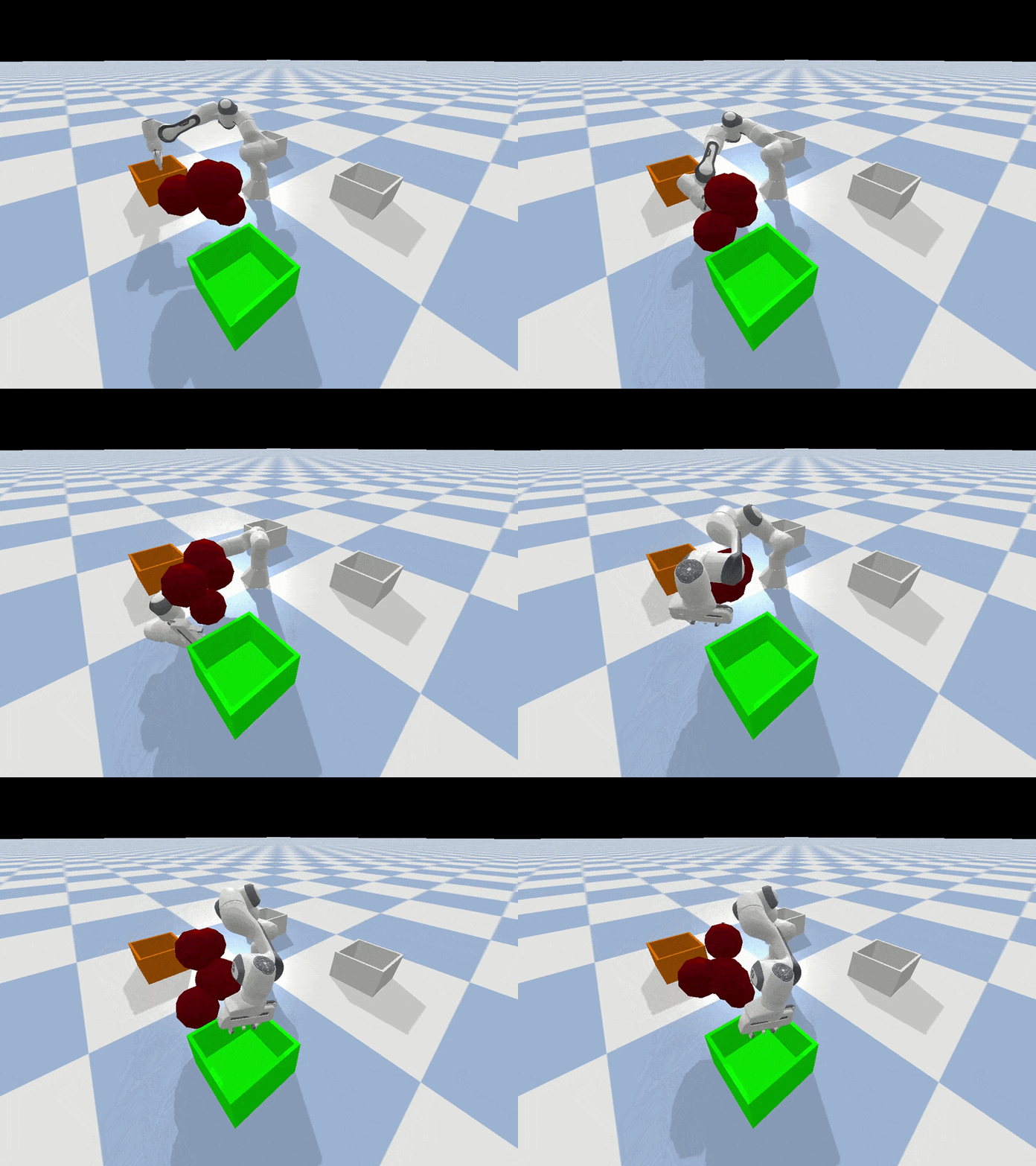
    Combines global candidates from layered graphs with local trajectory sampling for model predictive control. Batches simulator rollouts in MuJoCo XLA; available in hydrax.

    TMLR 2025, ICLR 2026 (J2C)OpenReviewCode
    BibTeX
    @article{le2025model,
      title         = {Model Tensor Planning},
      author        = {Le, An Thai and Nguyen, Khai and Vu, Minh Nhat and Carvalho, Jo{\~a}o and Peters, Jan},
      journal       = {Transactions on Machine Learning Research},
      issn          = {2835-8856},
      year          = {2025},
      url           = {https://openreview.net/forum?id=fk1ZZdXCE3},
      eprint        = {2505.01059},
      archivePrefix = {arXiv},
      primaryClass  = {cs.RO}
    }
  2. Representative paper: Global Tensor Motion Planning GTMP

    An Thai Le, Kay Pompetzki, João Carvalho, Joe Watson, Julen Urain, Armin Biess, Georgia Chalvatzaki, Jan Peters

    Uses tensor operations over a layered graph to search many smooth motion paths in parallel. Produces batches of spline paths, with probabilistic completeness under the paper's assumptions.

    IEEE RA-L 2025, ICRA 2026DOIarXivCode
    BibTeX
    @article{le2025global,
      title         = {Global Tensor Motion Planning},
      author        = {Le, An Thai and Pompetzki, Kay and Carvalho, Jo{\~a}o and Watson, Joe and Urain, Julen and Biess, Armin and Chalvatzaki, Georgia and Peters, Jan},
      journal       = {IEEE Robotics and Automation Letters},
      volume        = {10},
      number        = {7},
      pages         = {7302--7309},
      year          = {2025},
      doi           = {10.1109/LRA.2025.3575307},
      eprint        = {2411.19393},
      archivePrefix = {arXiv},
      primaryClass  = {cs.RO}
    }
  3. Representative paper: Motion Planning Diffusion: Learning and Adapting Robot Motion Planning with Diffusion Models MPD

    João Carvalho, An Thai Le, Piotr Kicki, Dorothea Koert, Jan Peters

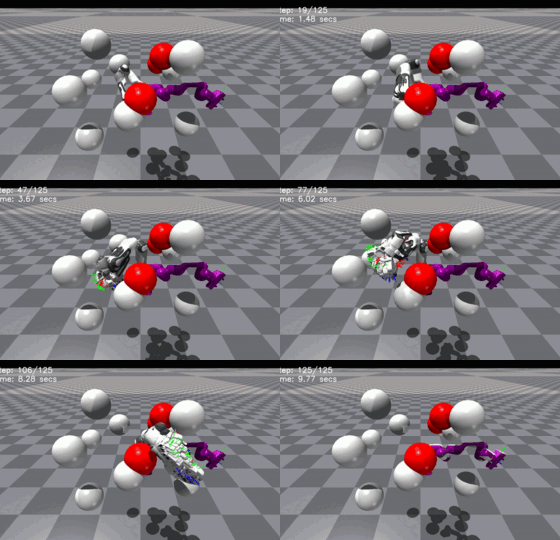
    Learns a diffusion prior over B-spline trajectories and guides sampling with task costs to generate motion plans. Evaluated from 2D tasks to 7-DoF arms, including real pick-and-place learned from human demonstrations.

    IEEE T-RO 2025, AAAI 2026 (journal track)DOIarXivCode
    BibTeX
    @article{carvalho2025motion,
      title         = {Motion Planning Diffusion: Learning and Adapting Robot Motion Planning With Diffusion Models},
      author        = {Carvalho, Jo{\~a}o and Le, An Thai and Kicki, Piotr and Koert, Dorothea and Peters, Jan},
      journal       = {IEEE Transactions on Robotics},
      volume        = {41},
      pages         = {4881--4901},
      year          = {2025},
      doi           = {10.1109/TRO.2025.3593109},
      eprint        = {2412.19948},
      archivePrefix = {arXiv},
      primaryClass  = {cs.RO}
    }
  4. FlowMP: Learning Motion Fields for Robot Planning with Conditional Flow Matching

    Khang Nguyen, An Thai Le, T. Pham, M. Huber, Jan Peters, Minh Nhat Vu

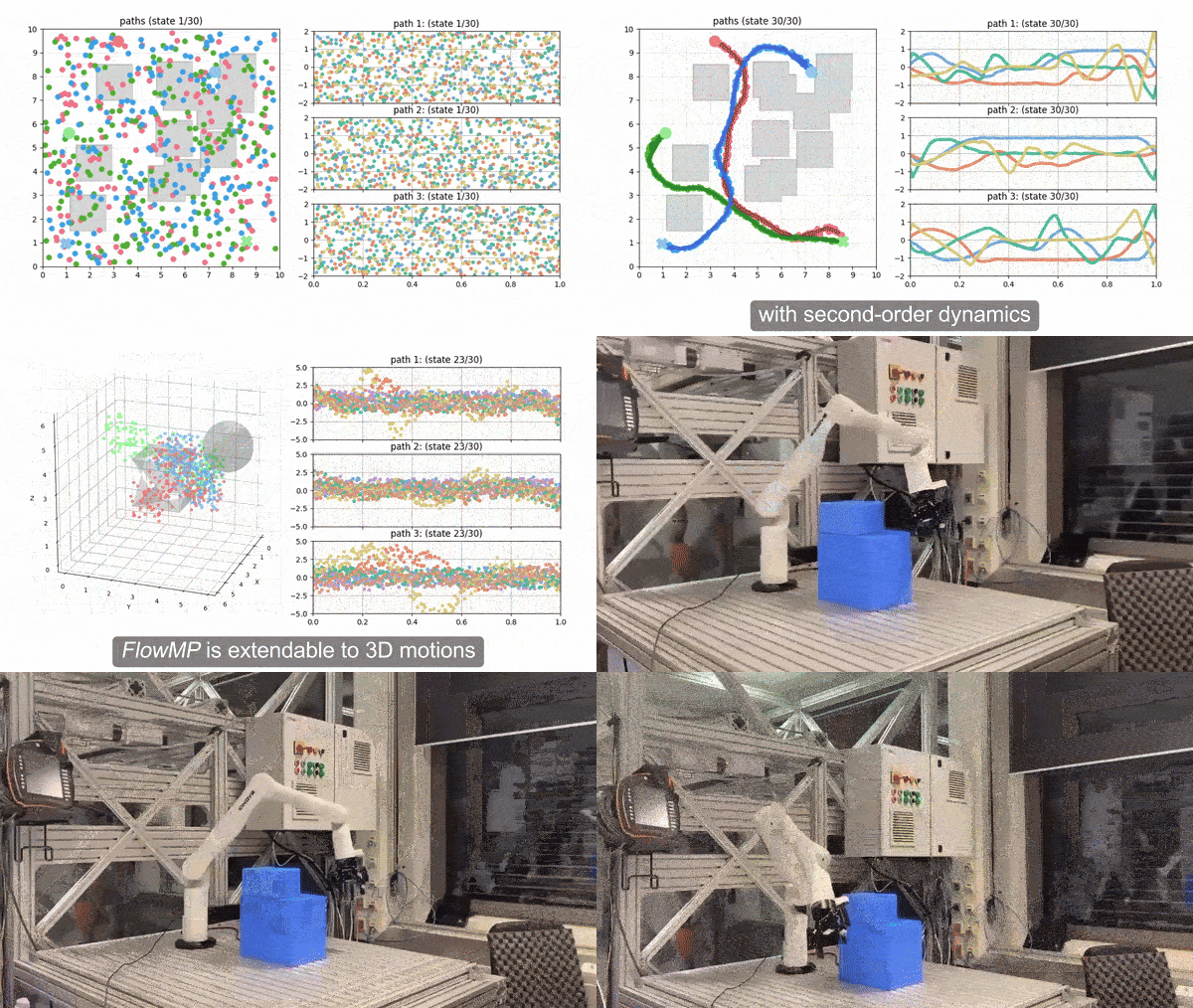
    Uses second-order conditional flow matching to learn acceleration-aware motion fields that generate smooth robot trajectories.

    IROS 2025arXivCode
    BibTeX
    @inproceedings{nguyen2025flowmp,
      title         = {{FlowMP}: Learning Motion Fields for Robot Planning with Conditional Flow Matching},
      author        = {Nguyen, Khang and Le, An Thai and Pham, Tien and Huber, Manfred and Peters, Jan and Vu, Minh Nhat},
      booktitle     = {IEEE/RSJ International Conference on Intelligent Robots and Systems (IROS)},
      pages         = {11291--11297},
      year          = {2025},
      doi           = {10.1109/IROS60139.2025.11246537},
      eprint        = {2503.06135},
      archivePrefix = {arXiv},
      primaryClass  = {cs.RO}
    }
  5. Machine Learning with Physics Knowledge for Prediction: A Survey

    Joe Watson, Chen Song, Oliver Weeger, Theo Gruner, An Thai Le, Kay Hansel, Ahmed Hendawy, Oleg Arenz, Will Trojak, Miles Cranmer, Carlo D'Eramo, Fabian Bülow, Tanmay Goyal, Jan Peters, Martin W. Hoffmann

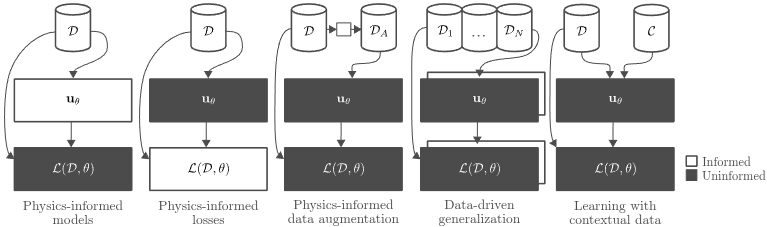
    Surveys how physics knowledge can guide machine-learning architectures, training objectives, and data, with a focus on partial differential equations and open-source tools.

    TMLR 2025arXiv
    BibTeX
    @article{watson2025machine,
      title         = {Machine Learning with Physics Knowledge for Prediction: A Survey},
      author        = {Watson, Joe and Song, Chen and Weeger, Oliver and Gruner, Theo and Le, An Thai and Hansel, Kay and Hendawy, Ahmed and Arenz, Oleg and Trojak, Will and Cranmer, Miles and D'Eramo, Carlo and B{\"u}low, Fabian and Goyal, Tanmay and Peters, Jan and Hoffmann, Martin W.},
      journal       = {Transactions on Machine Learning Research},
      issn          = {2835-8856},
      year          = {2025},
      url           = {https://openreview.net/forum?id=ZiJYahyXLU},
      note          = {Survey Certification},
      eprint        = {2408.09840},
      archivePrefix = {arXiv},
      primaryClass  = {cs.LG}
    }

2024

  1. Structure-Aware E(3)-Invariant Molecular Conformer Aggregation Networks ConAN

    D.M.H. Nguyen*, N. Lukashina*, T. Nguyen, An Thai Le, T. Nguyen, N. Ho, Jan Peters, D. Sonntag, V. Zaverkin, M. Niepert

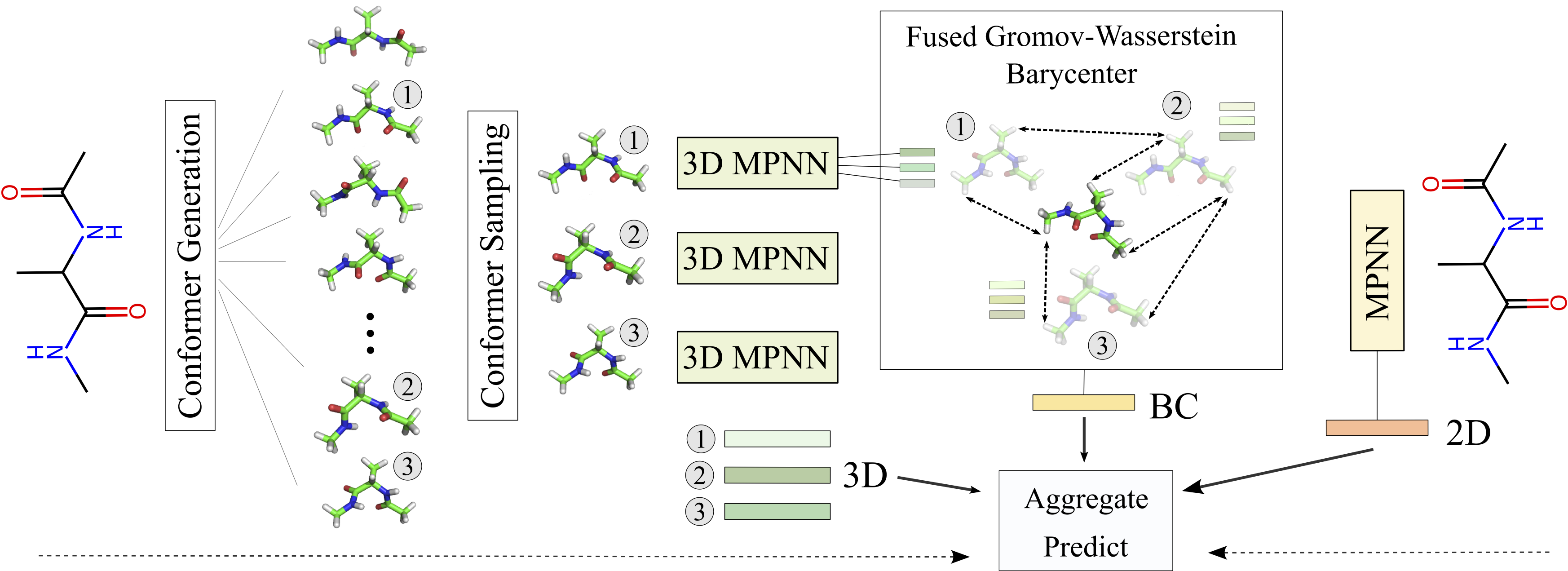
    Predicts molecular properties by combining a 2D molecular graph with multiple 3D conformers using a differentiable fused Gromov–Wasserstein barycenter. Predictions are invariant to rotations, translations, and reflections.

    ICML 2024arXivCode
    BibTeX
    @inproceedings{nguyen2024structure,
      title         = {Structure-Aware {E(3)}-Invariant Molecular Conformer Aggregation Networks},
      author        = {Nguyen, Duy Minh Ho and Lukashina, Nina and Nguyen, Tai and Le, An Thai and Nguyen, TrungTin and Ho, Nhat and Peters, Jan and Sonntag, Daniel and Zaverkin, Viktor and Niepert, Mathias},
      booktitle     = {International Conference on Machine Learning (ICML)},
      series        = {Proceedings of Machine Learning Research},
      volume        = {235},
      pages         = {37736--37760},
      publisher     = {PMLR},
      year          = {2024},
      url           = {https://proceedings.mlr.press/v235/nguyen24g.html},
      eprint        = {2402.01975},
      archivePrefix = {arXiv},
      primaryClass  = {cs.LG}
    }
  2. Dude: Dual Distribution-Aware Context Prompt Learning For Large Vision-Language Model

    D.M.H. Nguyen*, An Thai Le*, T.Q. Nguyen, N.T. Diep, T. Nguyen, D. Duong-Tran, Jan Peters, L. Shen, M. Niepert, D. Sonntag

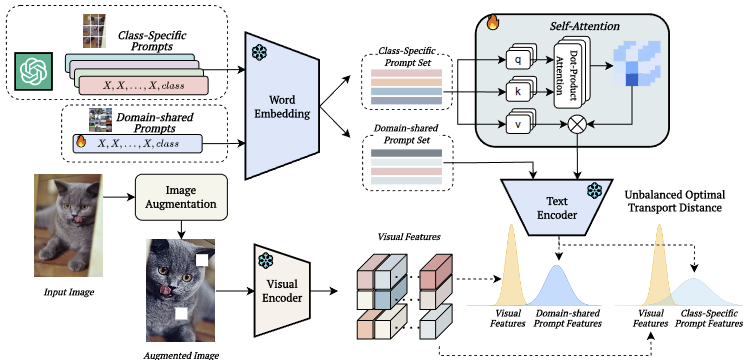
    Adapts vision-language models from few examples by aligning shared and LLM-generated class prompts with visual tokens through unbalanced optimal transport.

    ACML 2024PMLRarXiv
    BibTeX
    @inproceedings{nguyen2024dude,
      title         = {{Dude}: Dual Distribution-Aware Context Prompt Learning For Large Vision-Language Model},
      author        = {Nguyen, Duy Minh Ho and Le, An Thai and Nguyen, Trung Quoc and Diep, Nghiem Tuong and Nguyen, Tai and Duong-Tran, Duy and Peters, Jan and Shen, Li and Niepert, Mathias and Sonntag, Daniel},
      booktitle     = {Asian Conference on Machine Learning (ACML)},
      series        = {Proceedings of Machine Learning Research},
      volume        = {260},
      pages         = {687--702},
      publisher     = {PMLR},
      year          = {2024},
      url           = {https://proceedings.mlr.press/v260/nguyen25c.html},
      eprint        = {2407.04489},
      archivePrefix = {arXiv},
      primaryClass  = {cs.CV}
    }
  3. Grasp Diffusion Network: Learning Grasp Generators from Partial Point Clouds with Diffusion Models in SO(3)×R³ GDN

    João Carvalho, An Thai Le, Philipp Jahr, Qiao Sun, Julen Urain, Dorothea Koert, Jan Peters

    Generates grasp poses from a partial point cloud using diffusion on SO(3)×R³, with collision-cost guidance. Evaluated on grasping from raw depth observations.

    Preprint 2024arXiv
    BibTeX
    @misc{carvalho2024grasp,
      title         = {Grasp Diffusion Network: Learning Grasp Generators from Partial Point Clouds with Diffusion Models in {SO(3)}$\times${R}$^3$},
      author        = {Carvalho, Jo{\~a}o and Le, An Thai and Jahr, Philipp and Sun, Qiao and Urain, Julen and Koert, Dorothea and Peters, Jan},
      year          = {2024},
      eprint        = {2412.08398},
      archivePrefix = {arXiv},
      primaryClass  = {cs.RO}
    }

2023

  1. Representative paper: Accelerating Motion Planning via Optimal Transport MPOT

    An Thai Le, Georgia Chalvatzaki, Armin Biess, Jan Peters

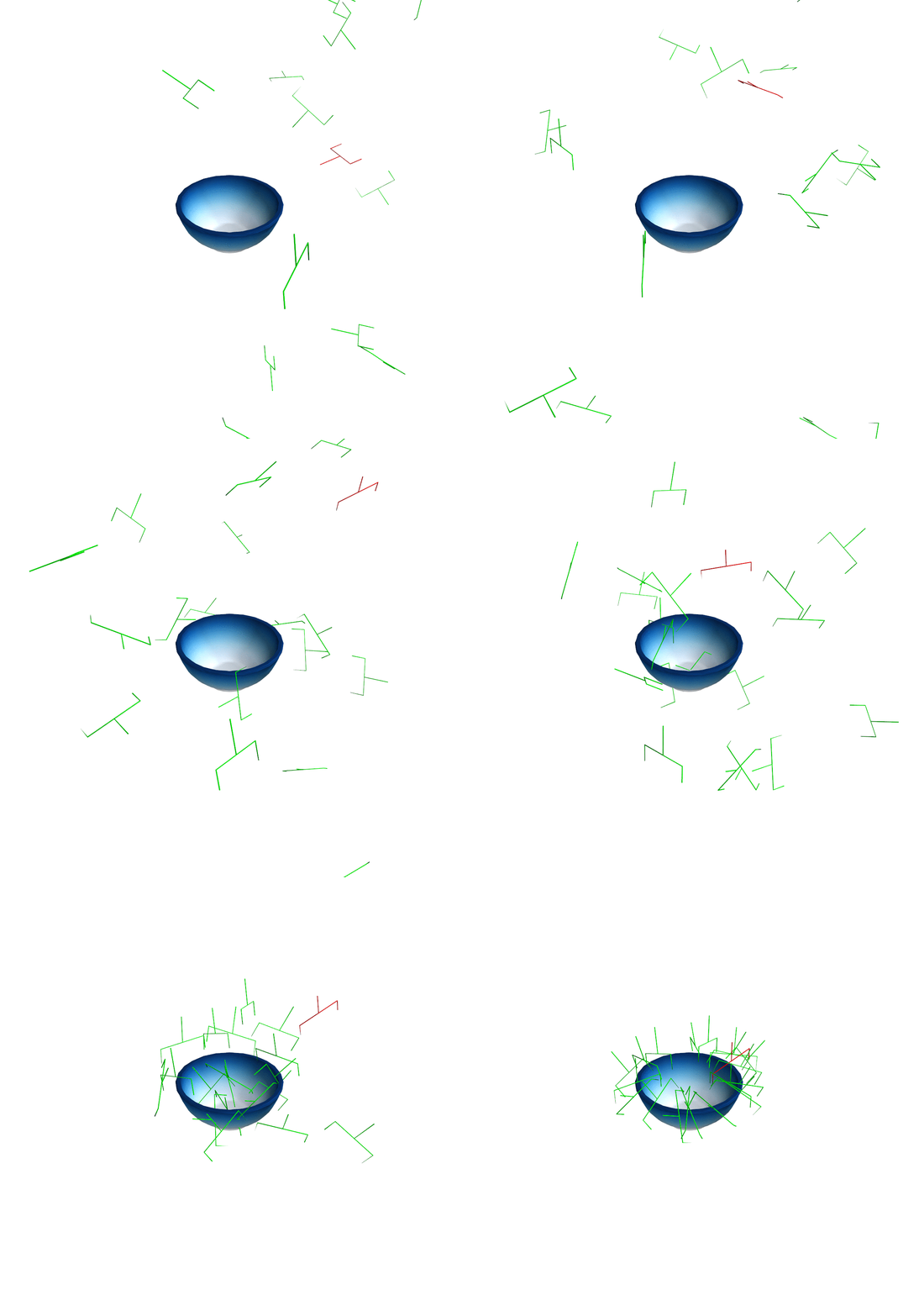
    Optimizes batches of trajectories without gradients. The Sinkhorn Step coordinates waypoint updates using entropic optimal transport, with a Gaussian-process smoothness prior.

    NeurIPS 2023arXivCode
    BibTeX
    @inproceedings{le2023accelerating,
      title         = {Accelerating Motion Planning via Optimal Transport},
      author        = {Le, An Thai and Chalvatzaki, Georgia and Biess, Armin and Peters, Jan},
      booktitle     = {Advances in Neural Information Processing Systems (NeurIPS)},
      volume        = {36},
      pages         = {78453--78482},
      publisher     = {Curran Associates, Inc.},
      year          = {2023},
      doi           = {10.52202/075280-3430},
      eprint        = {2309.15970},
      archivePrefix = {arXiv},
      primaryClass  = {cs.RO}
    }
  2. Hierarchical Policy Blending As Optimal Transport HiPBOT

    An Thai Le, Kay Hansel, Jan Peters, Georgia Chalvatzaki

    Uses unbalanced optimal transport in a look-ahead layer to choose weights for blending reactive Riemannian motion policies.

    L4DC 2023Proceedings
    BibTeX
    @inproceedings{le2023hierarchical,
      title         = {Hierarchical Policy Blending As Optimal Transport},
      author        = {Le, An Thai and Hansel, Kay and Peters, Jan and Chalvatzaki, Georgia},
      booktitle     = {Learning for Dynamics and Control Conference (L4DC)},
      series        = {Proceedings of Machine Learning Research},
      volume        = {211},
      pages         = {797--812},
      publisher     = {PMLR},
      year          = {2023},
      url           = {https://proceedings.mlr.press/v211/le23a.html},
      eprint        = {2212.01938},
      archivePrefix = {arXiv},
      primaryClass  = {cs.RO}
    }
  3. Motion Planning Diffusion: Learning and Planning of Robot Motions with Diffusion Models MPD

    João Carvalho, An Thai Le, Mark Baierl, Dorothea Koert, Jan Peters

    Learns diffusion priors over robot trajectories and generates goal-conditioned motion plans through denoising. The earlier conference version of Motion Planning Diffusion.

    IROS 2023arXiv
    BibTeX
    @inproceedings{carvalho2023motion,
      title         = {Motion Planning Diffusion: Learning and Planning of Robot Motions with Diffusion Models},
      author        = {Carvalho, Jo{\~a}o and Le, An Thai and Baierl, Mark and Koert, Dorothea and Peters, Jan},
      booktitle     = {IEEE/RSJ International Conference on Intelligent Robots and Systems (IROS)},
      pages         = {1916--1923},
      year          = {2023},
      doi           = {10.1109/IROS55552.2023.10342382},
      eprint        = {2308.01557},
      archivePrefix = {arXiv},
      primaryClass  = {cs.RO}
    }
  4. Learning to reason over scene graphs: a case study of finetuning GPT-2 into a robot language model for grounded task planning

    Georgia Chalvatzaki, Ali Younes, Daljeet Nandha, An Thai Le, L.F.R. Ribeiro, I. Gurevych

    Fine-tunes GPT-2 on scene graphs to turn long-horizon requests into subgoals for a planner. Evaluated on ALFRED.

    Frontiers in Robotics and AI 2023arXiv
    BibTeX
    @article{chalvatzaki2023learning,
      title         = {Learning to Reason over Scene Graphs: A Case Study of Finetuning {GPT-2} into a Robot Language Model for Grounded Task Planning},
      author        = {Chalvatzaki, Georgia and Younes, Ali and Nandha, Daljeet and Le, An Thai and Ribeiro, Leonardo F. R. and Gurevych, Iryna},
      journal       = {Frontiers in Robotics and AI},
      volume        = {10},
      pages         = {1221739},
      year          = {2023},
      doi           = {10.3389/frobt.2023.1221739},
      eprint        = {2305.07716},
      archivePrefix = {arXiv},
      primaryClass  = {cs.RO}
    }

2022

  1. Learning Implicit Priors for Motion Optimization StochGPMP

    Julen Urain*, An Thai Le*, Alexander Lambert*, Georgia Chalvatzaki, Byron Boots, Jan Peters

    Learns energy-based motion priors to initialize trajectory optimization or guide it through cost factors. Tested in simulation and on a real robot.

    IROS 2022arXivCode
    BibTeX
    @inproceedings{urain2022learning,
      title         = {Learning Implicit Priors for Motion Optimization},
      author        = {Urain, Julen and Le, An Thai and Lambert, Alexander and Chalvatzaki, Georgia and Boots, Byron and Peters, Jan},
      booktitle     = {IEEE/RSJ International Conference on Intelligent Robots and Systems (IROS)},
      pages         = {7672--7679},
      year          = {2022},
      doi           = {10.1109/IROS47612.2022.9981264},
      eprint        = {2204.05369},
      archivePrefix = {arXiv},
      primaryClass  = {cs.RO}
    }

2021

  1. Learning forceful manipulation skills from multi-modal human demonstrations

    An Thai Le, Meng Guo, Niels van Duijkeren, L. Rozo, R. Krug, A.G. Kupcsik, M. Bürger

    Learns insertion, sliding, and twisting from demonstrations of pose and force, using attractor-based impedance control. Demonstrated in e-bike motor assembly.

    IROS 2021arXiv
    BibTeX
    @inproceedings{le2021learning,
      title         = {Learning Forceful Manipulation Skills from Multi-modal Human Demonstrations},
      author        = {Le, An Thai and Guo, Meng and van Duijkeren, Niels and Rozo, Leonel and Krug, Robert and Kupcsik, Andras G. and B{\"u}rger, Mathias},
      booktitle     = {IEEE/RSJ International Conference on Intelligent Robots and Systems (IROS)},
      pages         = {7770--7777},
      year          = {2021},
      doi           = {10.1109/IROS51168.2021.9636828},
      eprint        = {2109.04222},
      archivePrefix = {arXiv},
      primaryClass  = {cs.RO}
    }
  2. Hierarchical Human-Motion Prediction and Logic-Geometric Programming for Minimal Interference Human-Robot Tasks

    An Thai Le, P. Kratzer, S. Hagenmayer, M. Toussaint, Jim Mainprice

    Combines hierarchical human-motion prediction with logic-geometric replanning to reduce interference in shared workspaces. Evaluated on MoGaze.

    IEEE RO-MAN 2021arXiv
    BibTeX
    @inproceedings{le2021hierarchical,
      title         = {Hierarchical Human-Motion Prediction and Logic-Geometric Programming for Minimal Interference Human-Robot Tasks},
      author        = {Le, An Thai and Kratzer, Philipp and Hagenmayer, Simon and Toussaint, Marc and Mainprice, Jim},
      booktitle     = {IEEE International Conference on Robot and Human Interactive Communication (RO-MAN)},
      pages         = {7--14},
      year          = {2021},
      doi           = {10.1109/RO-MAN50785.2021.9515539},
      eprint        = {2104.08137},
      archivePrefix = {arXiv},
      primaryClass  = {cs.RO}
    }

Humanoid demos

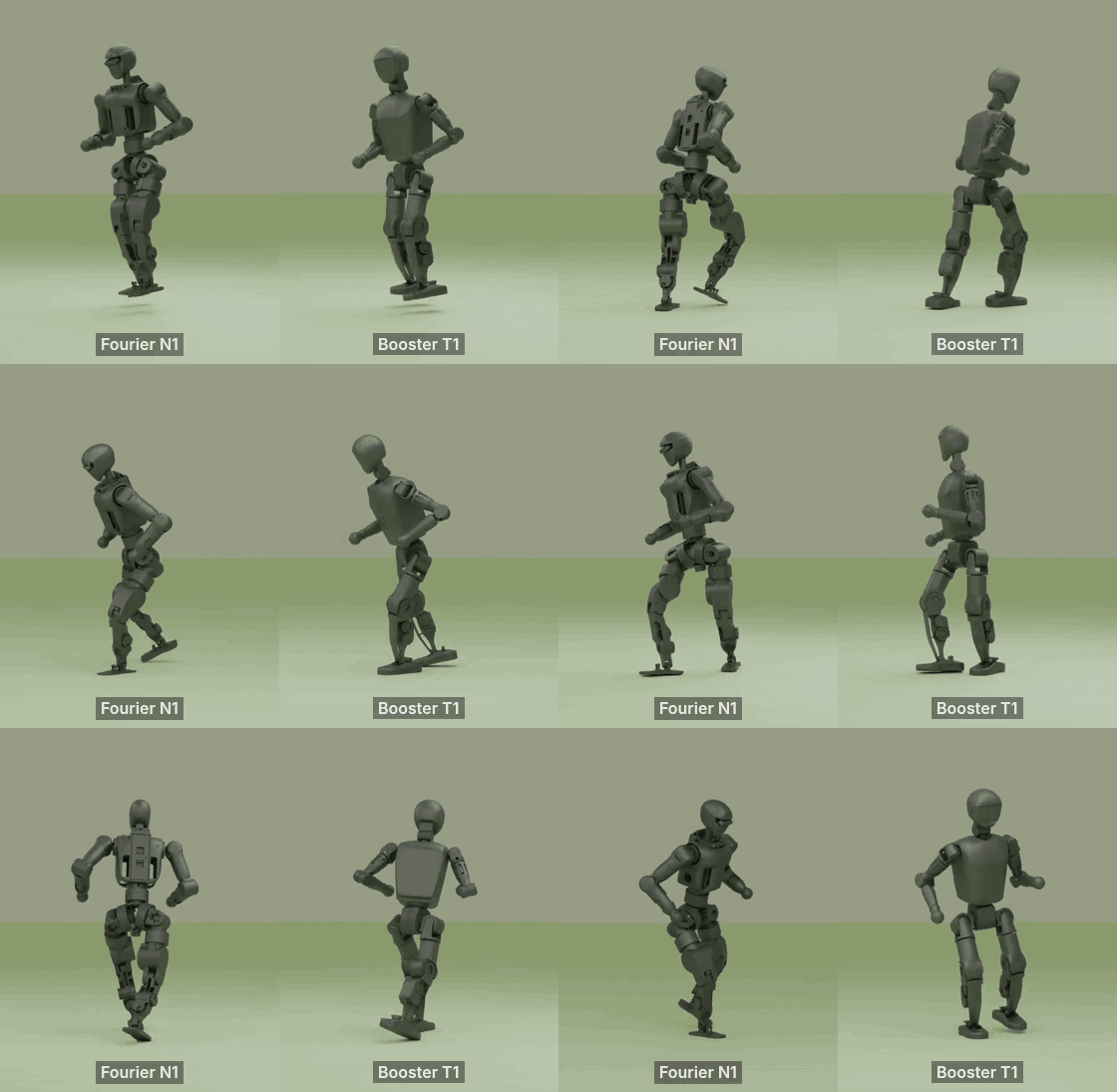
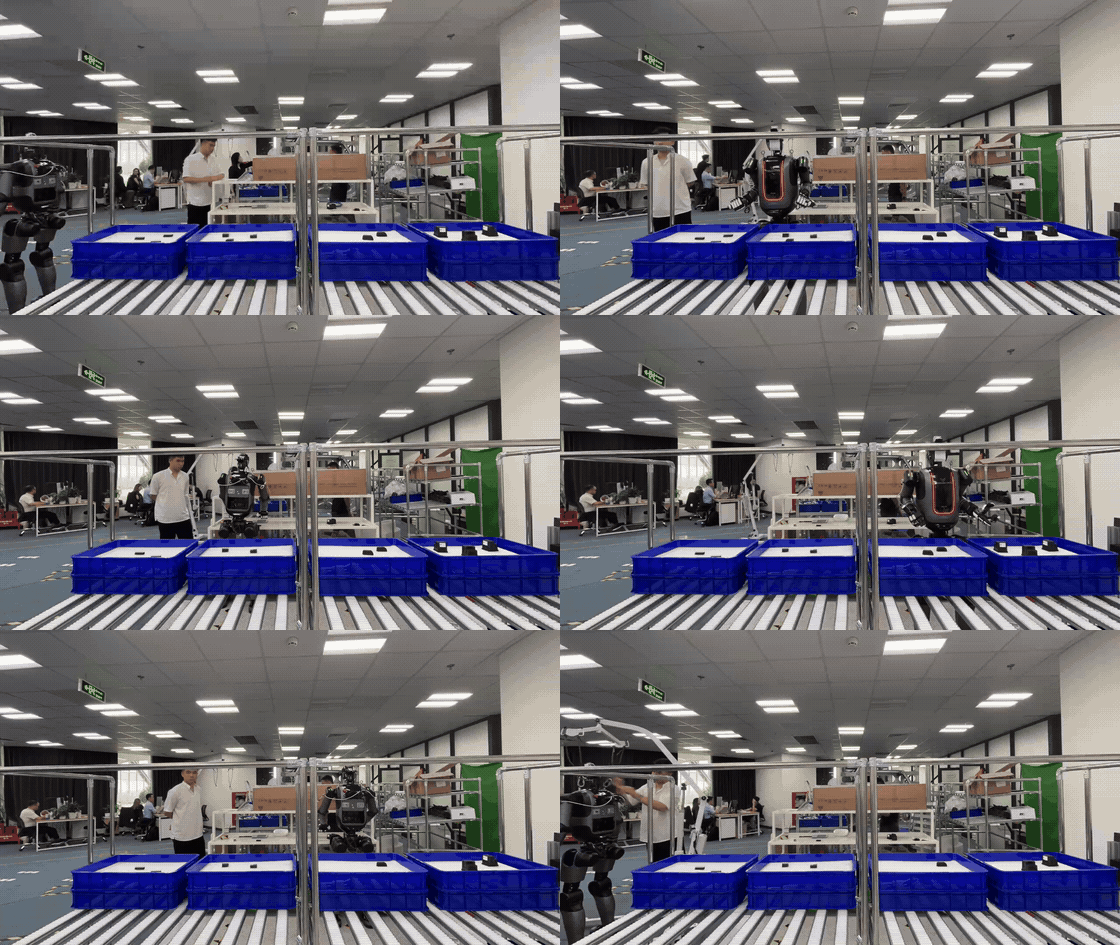
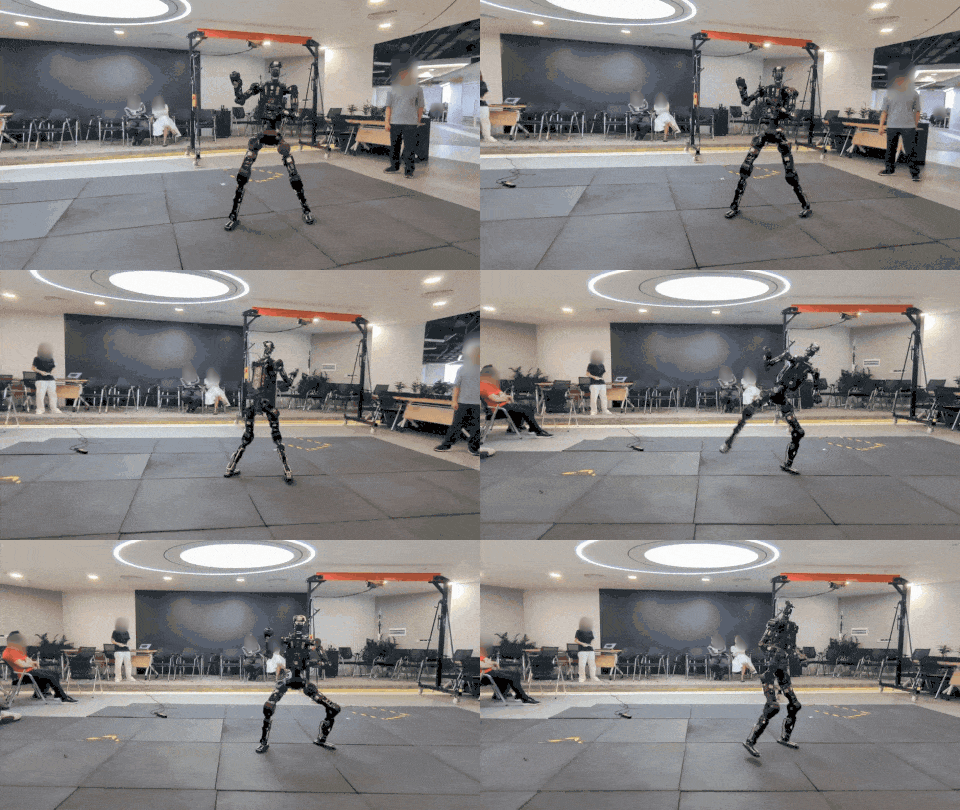
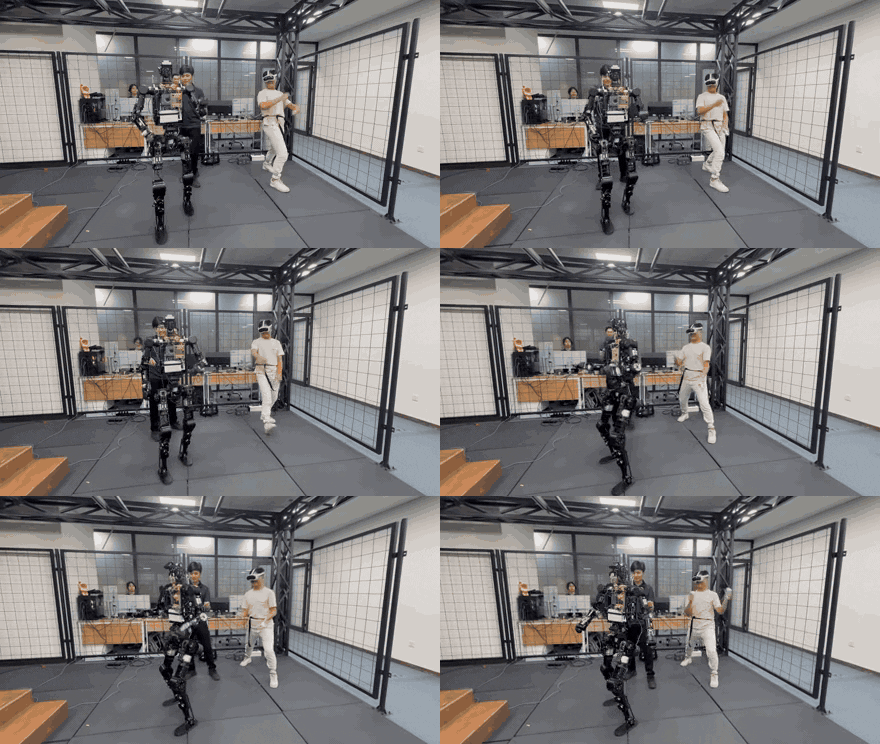
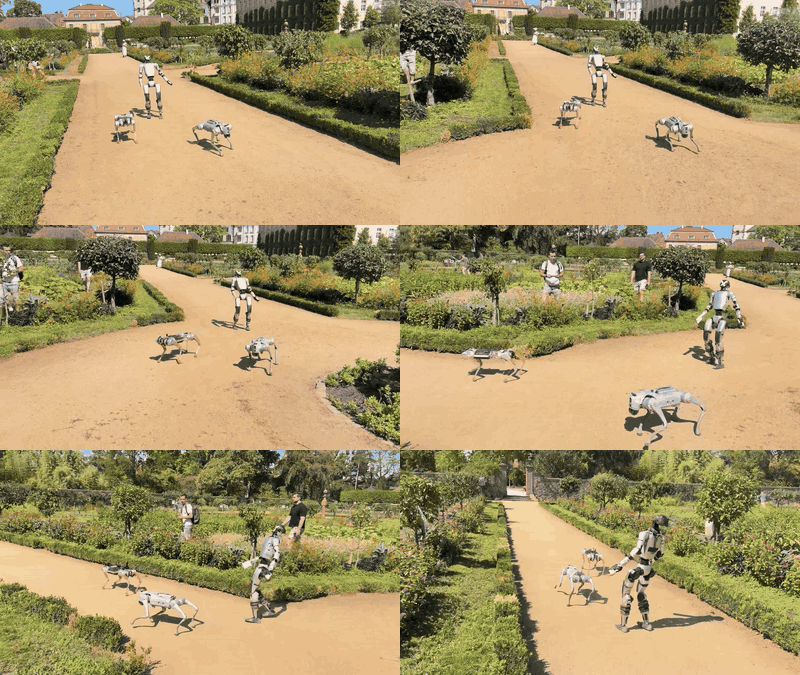
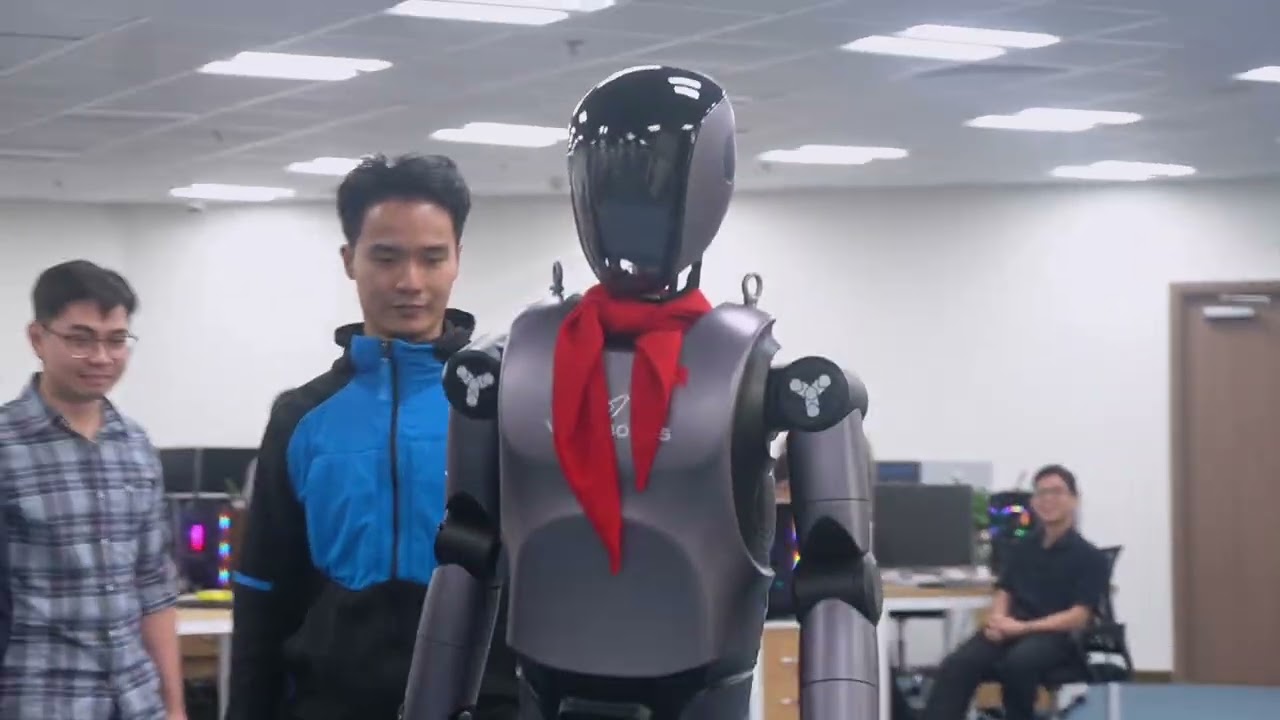
Our researchers and engineers at VinRobotics test learned locomotion, whole-body control, and physical interaction on real humanoids.

Compliant whole-body control

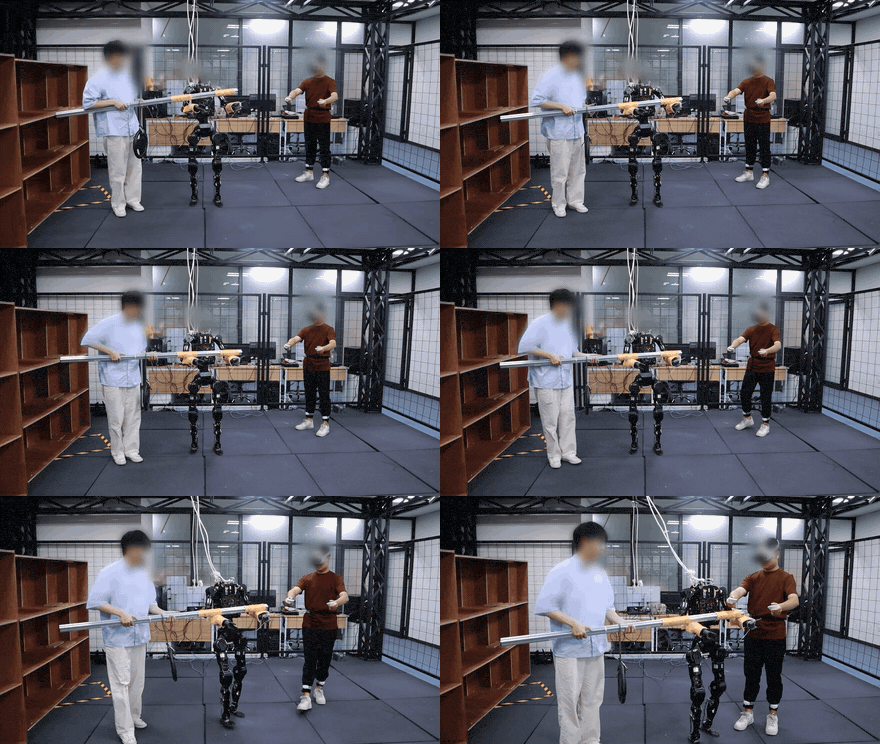
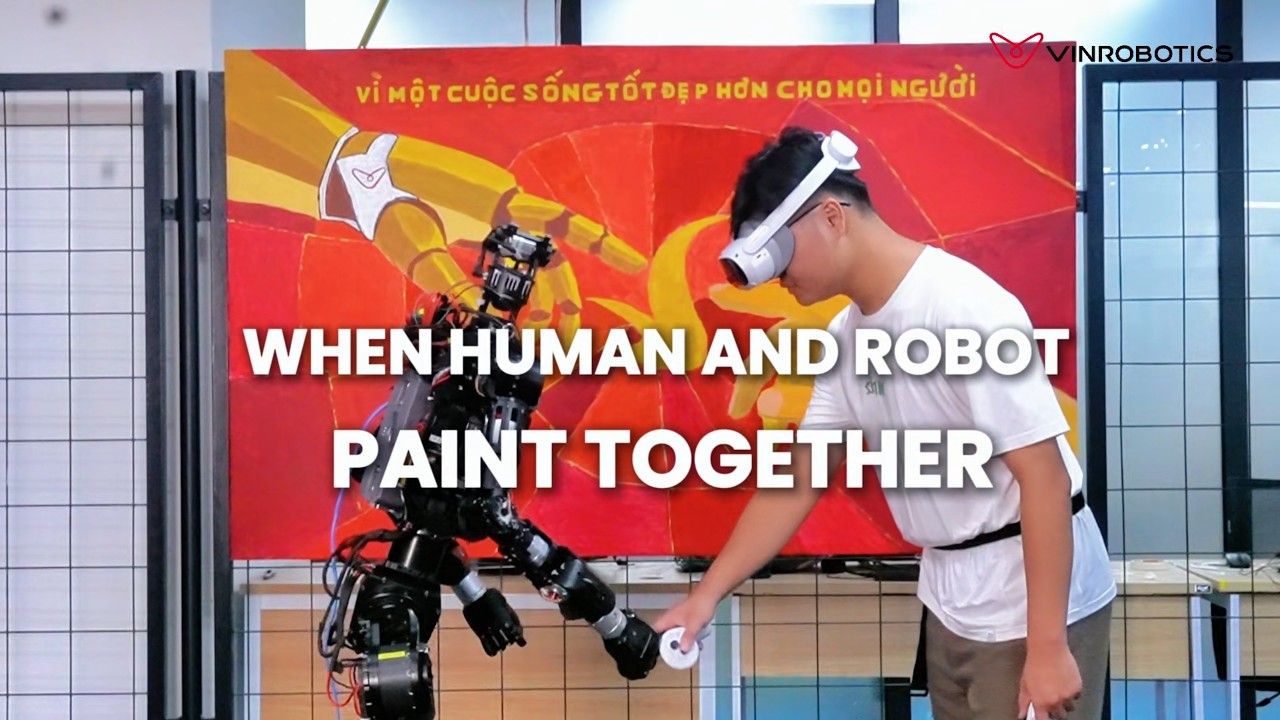
CompliantWBC uses proprioceptive force estimates to coordinate the arms, torso, and legs of the ~70 kg VR-M3 during contact. The demos show guided interaction and cooperative tasks; the paper's passivity analysis is local and assumes fixed stiffness.

Project page: Compliant whole-body control

Perceptive stair locomotion

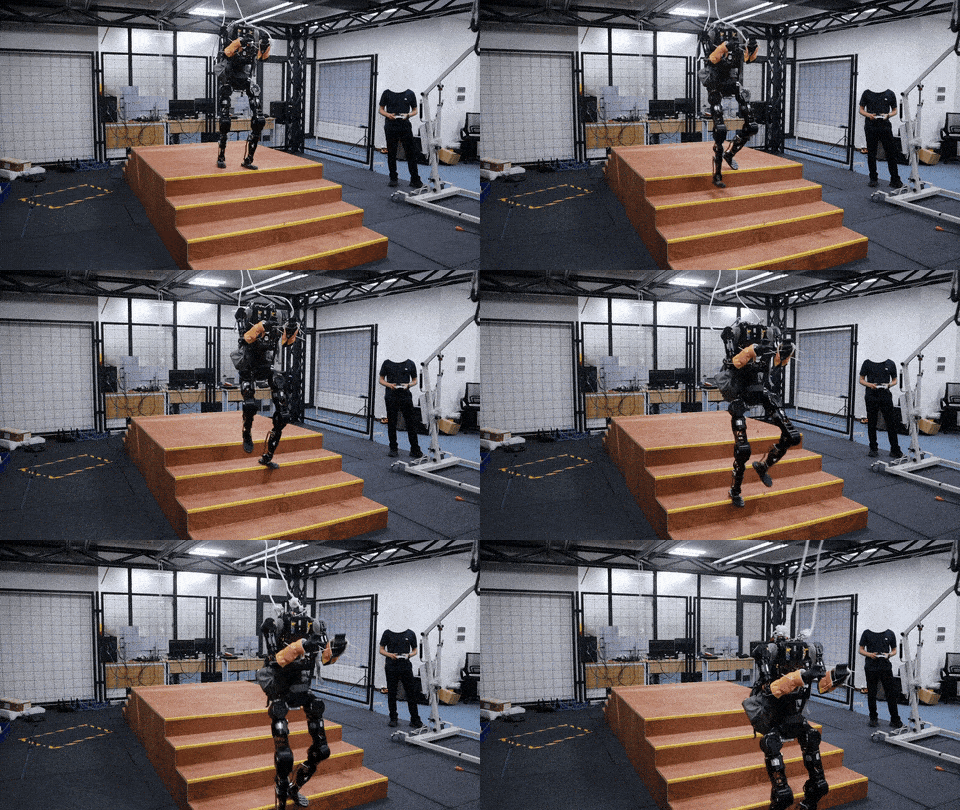
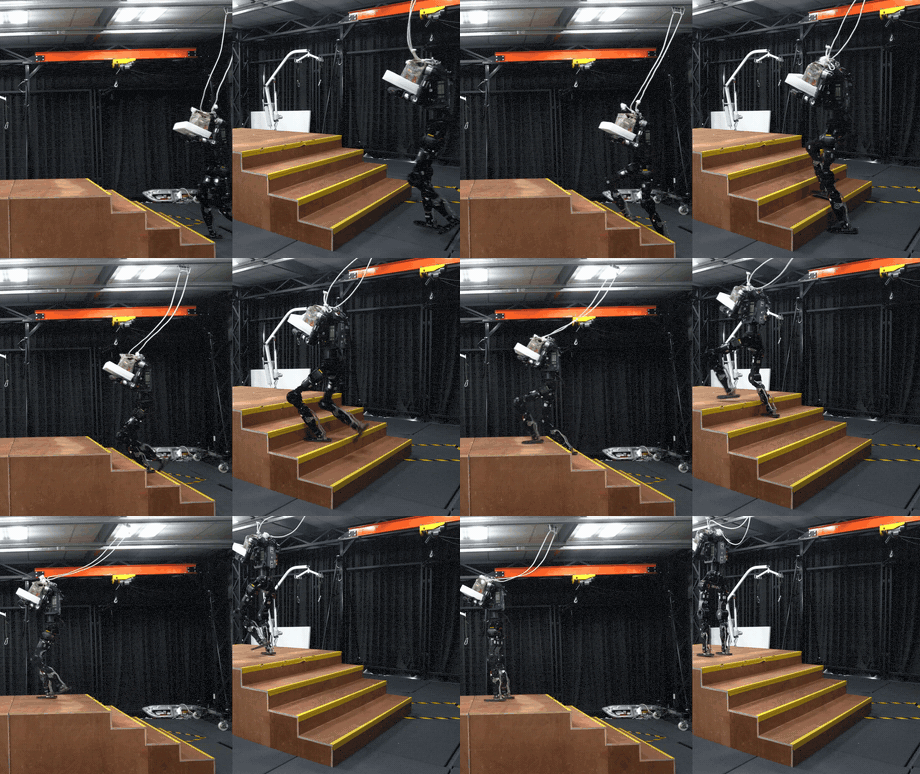
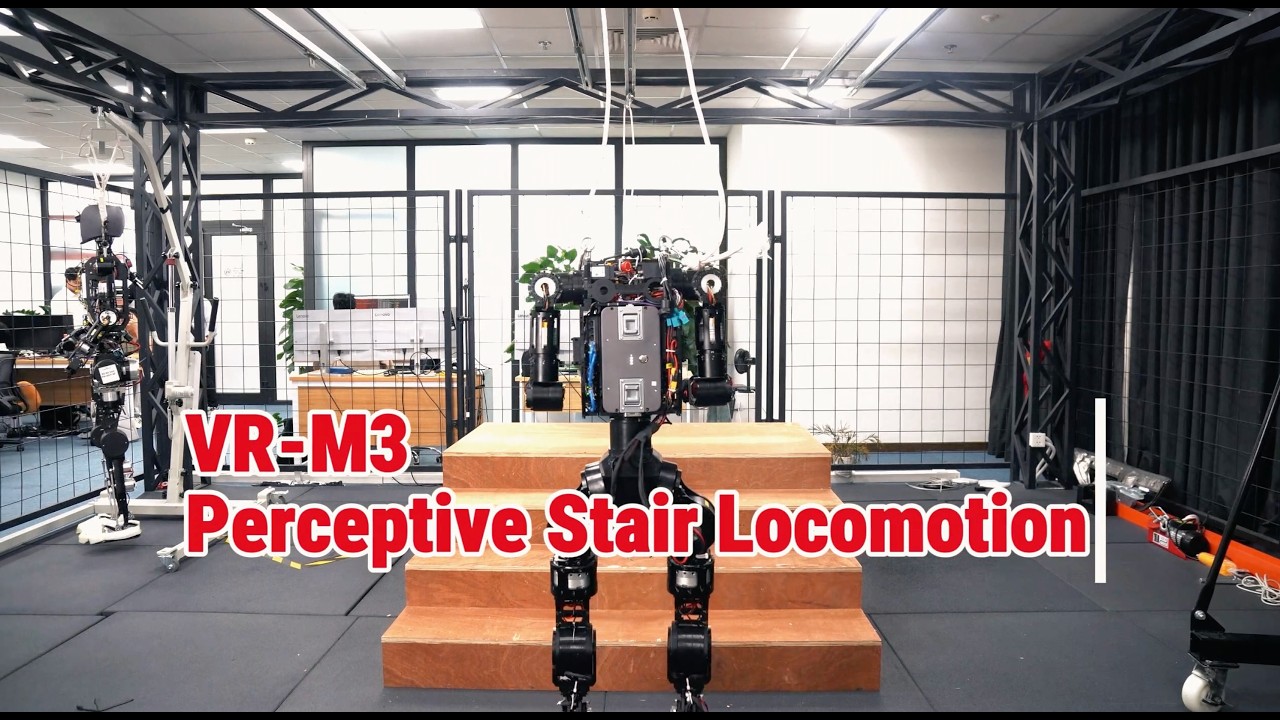
VR-M3 (~70 kg) climbs real staircases of varying geometry at up to 0.6 m/s, and carries a 5 kg payload on them. It uses a single onboard camera and a learned locomotion policy, with no LiDAR, motion capture or teleoperation.

Read article: Perceptive stair locomotion

Fast walking on VR-H3

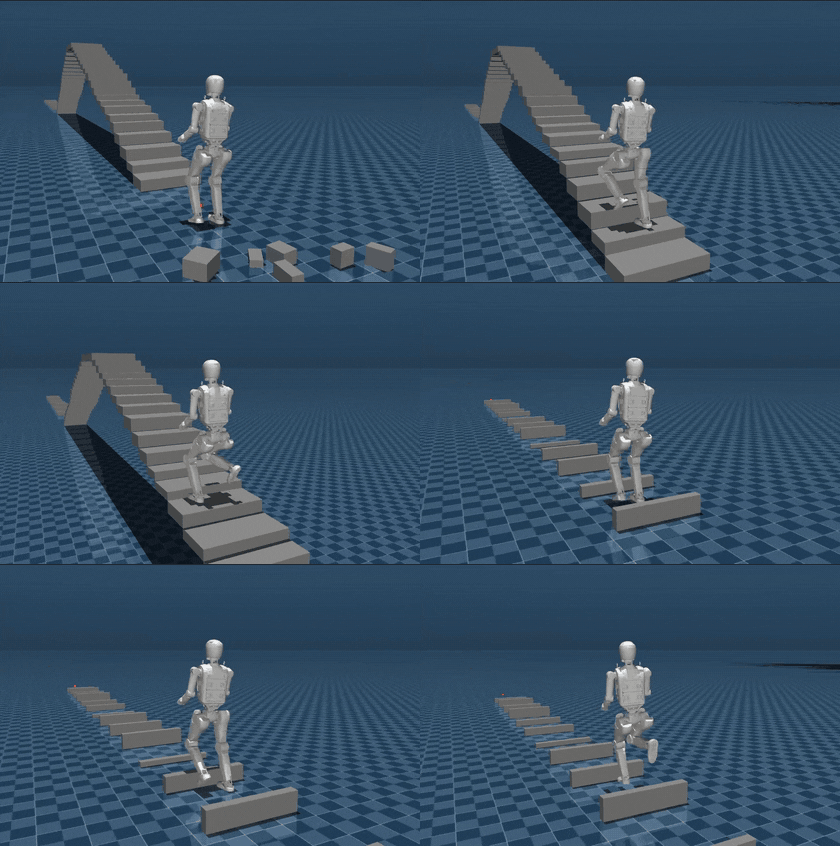
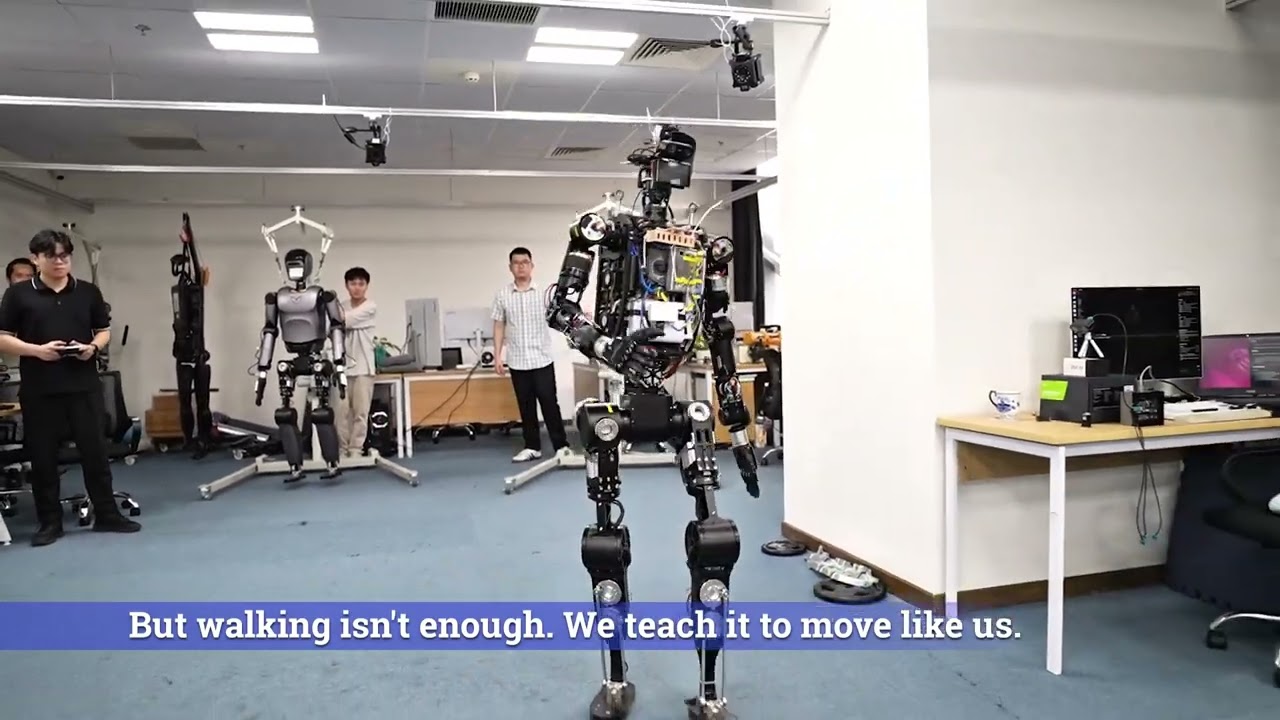
VR-H3 (178 cm, 85 kg) walks with an RL locomotion policy trained with phase-aware gait rewards, domain randomization, and a curriculum that raises difficulty only after the policy masters balance at each level.

Read article: Fast walking on VR-H3

Built from the motor up

In-house actuators and real-time EtherCAT communication support learned locomotion on our humanoid platform. The team reports walking at 1.5 m/s, reaching 1.8 m/s with controllers trained on human motion data.

Read article: Built from the motor up

Global debut

Platform preview for Computex and ICRA 2026: whole-body teleoperation, dynamic payload handling, MPC + RL locomotion, and perception-action learning.

Read article: Global debut

Join us

Our group is based at VinUniversity in Hanoi, with close ties to VinRobotics and IAS at TU Darmstadt. If you enjoy designing algorithms and understanding them deeply, and are willing to tinker with hardware, let's explore together!

How we work together

My role is to help students build independent research judgment. We work through the mathematics and code together, asking which assumptions matter and what evidence would change our minds. Starting from first principles helps turn rough ideas into questions we can test. There is room to get things wrong and rethink; the goal is for students to develop their own directions and feel comfortable questioning mine.

Open tracks

How to apply

  • Email an@robot-learning.de with the subject [Join][<track>] <Your Name>.
  • Attach a CV and a transcript, and link to code you wrote.
  • Add a short paragraph (under 300 words) on one of our papers: an idea you found interesting, a question about how it works, or something you would like to try. This helps us understand your interests.

I read emails with this subject line first, but may not be able to reply to every message. Thanks for your patience.

Group

Students, residents, alumni, and collaborators who make this work possible. Our mentoring approach and open tracks are above.

MSc students

Dinh Van The Long

VinRobotics residents

Trinh Thi Cuc
Dang Truong Duy
Le Anh Chien
Nguyen Viet Duong
Ly Phuc Thanh
Do Tan Dung
Ho Thinh Hung
Ha Thien Loc
Nguyen Quang Tan
Ho Trong Bao
Nguyen Dang Khanh
Le Van Minh
Nguyen Doan Hoang
Nguyen Minh Hoang
Dao Duc Thinh
Truong Minh Hoang
Nguyen Truong Chinh

Alumni

Phuong Tuan Dat
Magnus Dierking
Caio Freitas
Qiao Sun
Denis Andrić
Sebastian Zach

Collaborators

Zachary Kingston Purdue University
Meng Guo Peking University
Ngo Anh Vien VinRobotics
Jan Peters TU Darmstadt
Georgia Chalvatzaki TU Darmstadt
Viet T. Nguyen University of Würzburg

Open source

Research implementations and deployment tools developed with students and collaborators. For planning, try GTMP or MPOT; for policy deployment, vla.cpp; for numerical relativity, warpax. Bug reports, reproducible examples, and thoughtful questions are welcome.

VinRobotics/vla.cpp C++ runtime for onboard inference with eleven vision-language-action models. C++Stars: 198Forks: 34 anindex/mpot Gradient-free trajectory optimization with optimal transport in PyTorch. NeurIPS 2023. PythonStars: 71Forks: 11 anindex/mtp Global and local trajectory sampling for model predictive control in JAX. TMLR 2025 & ICLR 2026. PythonStars: 44Forks: 2 anindex/gtmp Parallel motion planning with layered graphs and tensor operations in JAX. RA-L 2025 & ICRA 2026. PythonStars: 40Forks: 5 anindex/polystep Optimal-transport training for non-differentiable networks using only forward evaluations. TMLR 2026. PythonStars: 33Forks: 1 anindex/warpax Vectorized auto-diff in JAX for checking energy conditions in warp drive spacetimes. CQG 2026. PythonStars: 3Forks: 1 anindex/penrose_process Rocket-flyby simulations testing energy extraction and escape around rotating black holes. Phys. Rev. D 2026. PythonStars: 2Forks: 0 anindex/aac Learned compression of landmark heuristics for A* search, preserving admissibility by construction. PythonStars: 4Forks: 0 VinRobotics/vinrobotics_mjlab RL training pipeline for high-payload humanoid locomotion, built on MuJoCo Warp. PythonStars: 44Forks: 9 VinRobotics/model-quantization-recipes Quantization recipes for language and speech models, with deployment checks. PythonStars: 35Forks: 6 anindex/note_model_opt A collection of notes and examples on model deployment. Stars: 27Forks: 2 vincekurtz/hydrax (contributor) Sampling-based model predictive control on GPU with JAX / MJX. Includes MTP. PythonStars: 304Forks: 53

Teaching & mentoring

Start with a small example, work through the mathematics, then implement it and test the assumptions. That is the spirit of our student projects and mentoring: learning to ask good questions and develop independent research judgment.

Courses at TU Darmstadt

Open learning resources

Community & service

Editorial and reviewing roles

Associate Editor
ICRA 2027
Area Chair
ICLR 2027, CoRL 2026, RLC
Conference reviewer
IROS, ICRA, RSS, L4DC, NeurIPS, ICML, ICLR, AAAI
Journal reviewer
IEEE RA-L, IEEE T-RO, Neurocomputing, TMLR, Frontiers in Robotics and AI

Selected invited talks

Experience & education

  1. Oct 2025–present
    Hanoi, Vietnam

    Assistant Professor

    Building a research group on efficient learning and planning for robot locomotion and manipulation.

  2. Oct 2025–present
    Darmstadt, Germany

    Visiting Professor

    Co-advising MSc and PhD students at IAS on robot learning research.

  3. Aug 2025–present
    Hanoi, Vietnam

    Director of Foundation AI

    • RL stack for high-payload humanoid locomotion
    • Humanoid VLA architecture and training recipe
    • Model optimization and edge-deployment toolchain
  4. 2022–2025
    Darmstadt, Germany

    Ph.D. in Computer Science

    Thesis: Tensor Search Methods for Vectorizing Motion Planning, supervised by Prof. Jan Peters.

  5. 2019–2021
    Stuttgart, Germany

    M.Sc. Information Technology

    Thesis: Learning task-parameterized Riemannian motion policies, supervised by Dr. Jim Mainprice and Dr. Meng Guo. Graduated first class. Info-Preis for the best diploma, Sony Research Award, Deutschlandstipendium.

  6. May–Dec 2020
    Renningen, Germany

    Research Intern

    Forceful imitation learning for e-bike assembly, hosted by Dr. Meng Guo in the robotics team.

  7. Nov 2019–Apr 2020
    Stuttgart, Germany

    Research Assistant

    Implemented back-end functionality in the DASH project; maintained and configured HPC systems.

  8. 2015–2019
    Frankfurt, Germany

    B.Eng. Electrical Engineering and Information Technology

    Thesis: Approaches to solve the kidnapped robot problem. Graduated first class. DAAD, AmCham and eSilicon scholarships.

  9. Jan–May 2017
    Ho Chi Minh City, Vietnam

    Engineer Intern

    Designed data analysis systems for high-volume manufacturing unit-test data; validated and reported quality of the Thunderbolt manufacturing line.